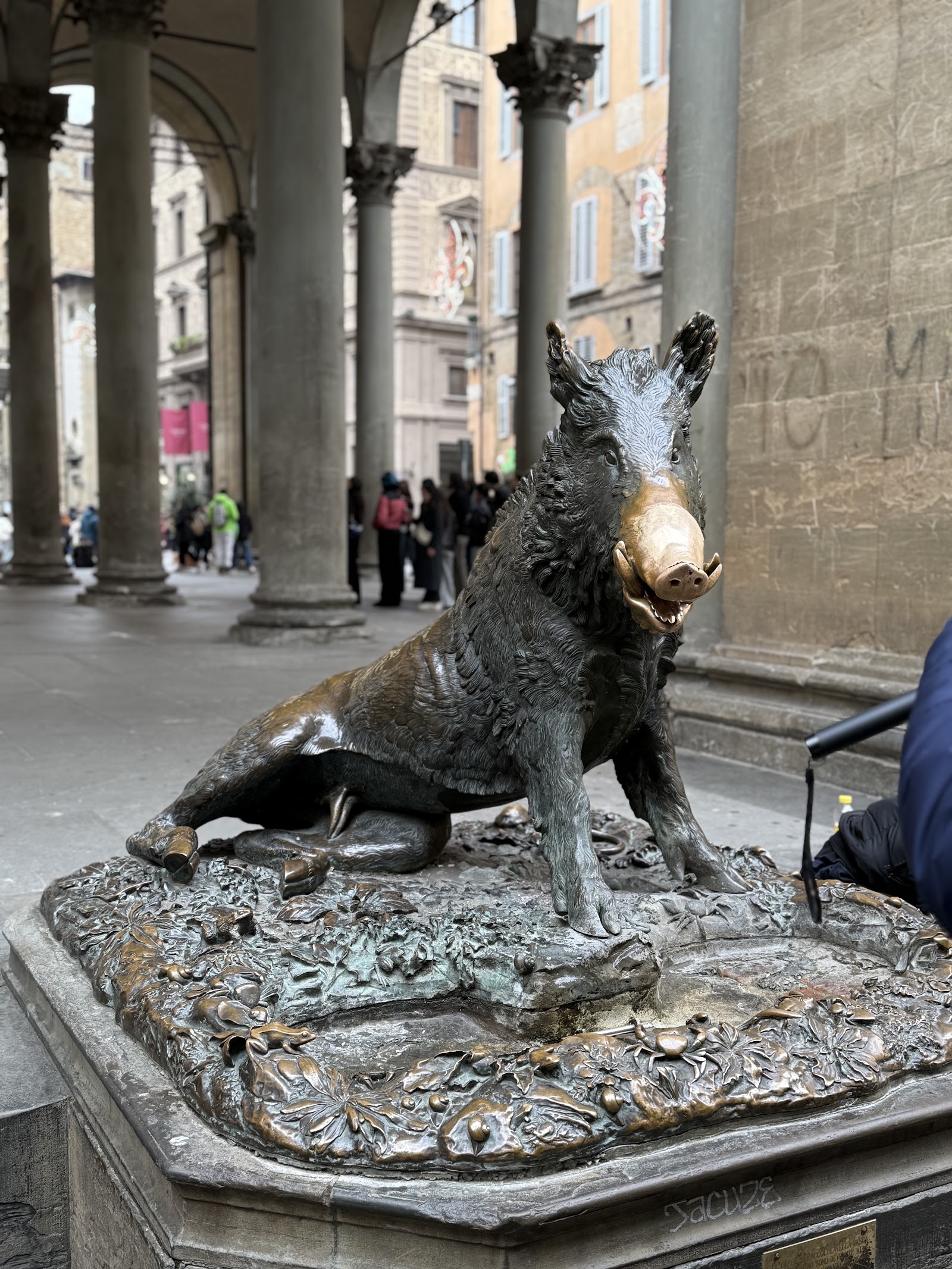
You'll probably spot the line before you spot the statue. Under this open-sided market loggia sits a life-sized bronze boar, mid-crouch, with a small queue of people taking turns rubbing its nose. His name is the Porcellino — which means the piglet, which is generous, because he is very clearly a full-grown wild boar with tusks. Look at his snout. It's polished to a bright gold, while the rest of him is dark, dull bronze. That gold is nothing but four hundred years of human hands.
The ritual goes like this. You rub the snout for luck. Then you set a coin in his mouth and let it drop. Below his chin there's a grate, and if your coin falls through, the story says you'll return to Florence one day. If it clinks and stays on the ledge — different kind of luck. People take this very seriously for something involving a metal pig.
The boar is a copy of a copy. The original was an ancient marble, itself carved from a Greek one, that ended up in the Medici collection. In the sixteen hundreds
a sculptor cast this bronze version to sit here at the market and spout water, and he's been the unofficial mascot of the city ever since. He even has a literary fan — Hans Christian Andersen, the fairy-tale writer, came to Florence, met this pig, and wrote an entire story about a poor boy who climbs onto the bronze boar at midnight and rides it through the sleeping city.
And the little pig got a