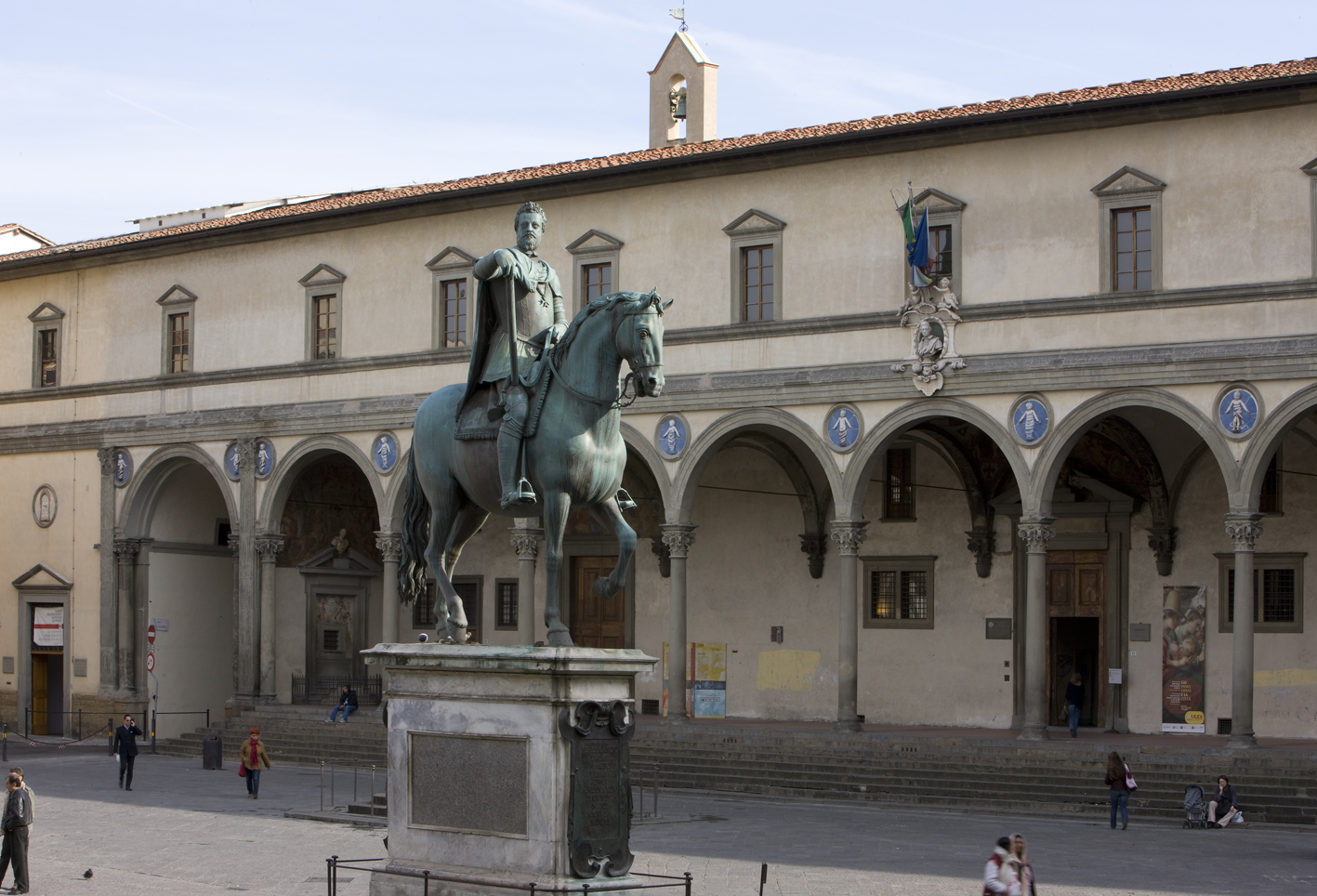
Look at the long, calm arcade running along this side of the square — a row of rounded arches on slender columns, so simple and so exactly right that you might not register you're looking at a landmark at all. This is the Ospedale degli Innocenti, the Hospital of the Innocents, and architects call it the first true Renaissance building. It is also, once again, Brunelleschi. Before the dome, before any of the fame, this quiet arcade is where he started.
After Rome, and before the cathedral handed him the dome, the silk guild hired him to design a home for abandoned children. And instead of a fortress or a showpiece, he drew this: a run of perfect half-circle arches, each bay a clean cube, everything sized by simple whole-number ratios — rational, restful, human. He wasn't decorating. He was proving a quiet argument, that beauty comes from proportion, from parts held in honest relation to one another. Nearly every balanced building that came after it, for centuries, in some way begins o
n this sidewalk.
Look up into the spandrels — the spaces between the arches — at the round blue-and-white ceramic medallions. Each one is a baby, wrapped tight in swaddling bands. They were added a little later, by the della Robbia workshop, and they tell you plainly, without a single word, what this building was for.
The name tells you the rest. Innocenti — the Innocents — after the children in