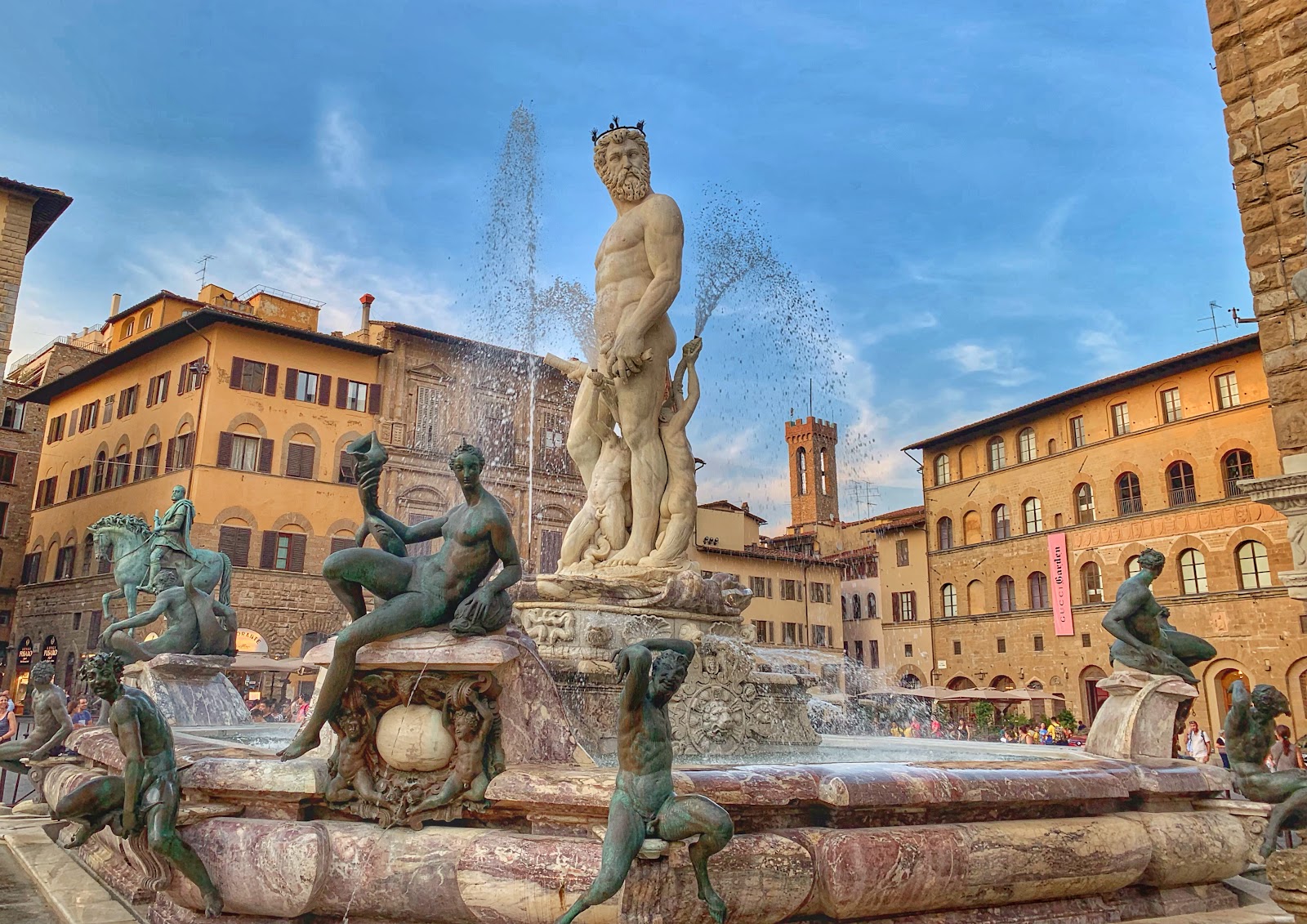
You've walked into the Piazza della Signoria — the political heart of Florence for seven hundred years, and one of the loveliest open squares in the world. Somewhere near the great fountain with the pale sea god, set flat into the pavement, there's a round marble marker. If you can find it in the stone, stand near it. It marks the spot where the city burned a man alive, on the exact ground where, one year earlier, that same man had made the city burn its own beauty.
His name was Girolamo Savonarola. A Dominican friar — plain, intense, physically unremarkable, and one of the most electrifying preachers who ever lived. When the Medici were thrown out of Florence in fourteen ninety-four, Savonarola filled the hole. Not with an army. With sermons. He told Florence — the richest, most artistic city in Europe — that its paintings, its books, its mirrors, its silk dresses, its perfumes and card games were all vanity, all rot, all a one-way road to Hell. And the city, terrified and thrilled,
believed him.
In fourteen ninety-seven, his followers built a colossal pyramid of "vanities" right here in this square. People climbed it and threw their own belongings onto the pile — mirrors, cosmetics, fine gowns, playing cards, musical instruments, books, paintings. By some accounts, artists walked up and laid their own canvases on the heap. Then they set the whole mountain of it on fire. His