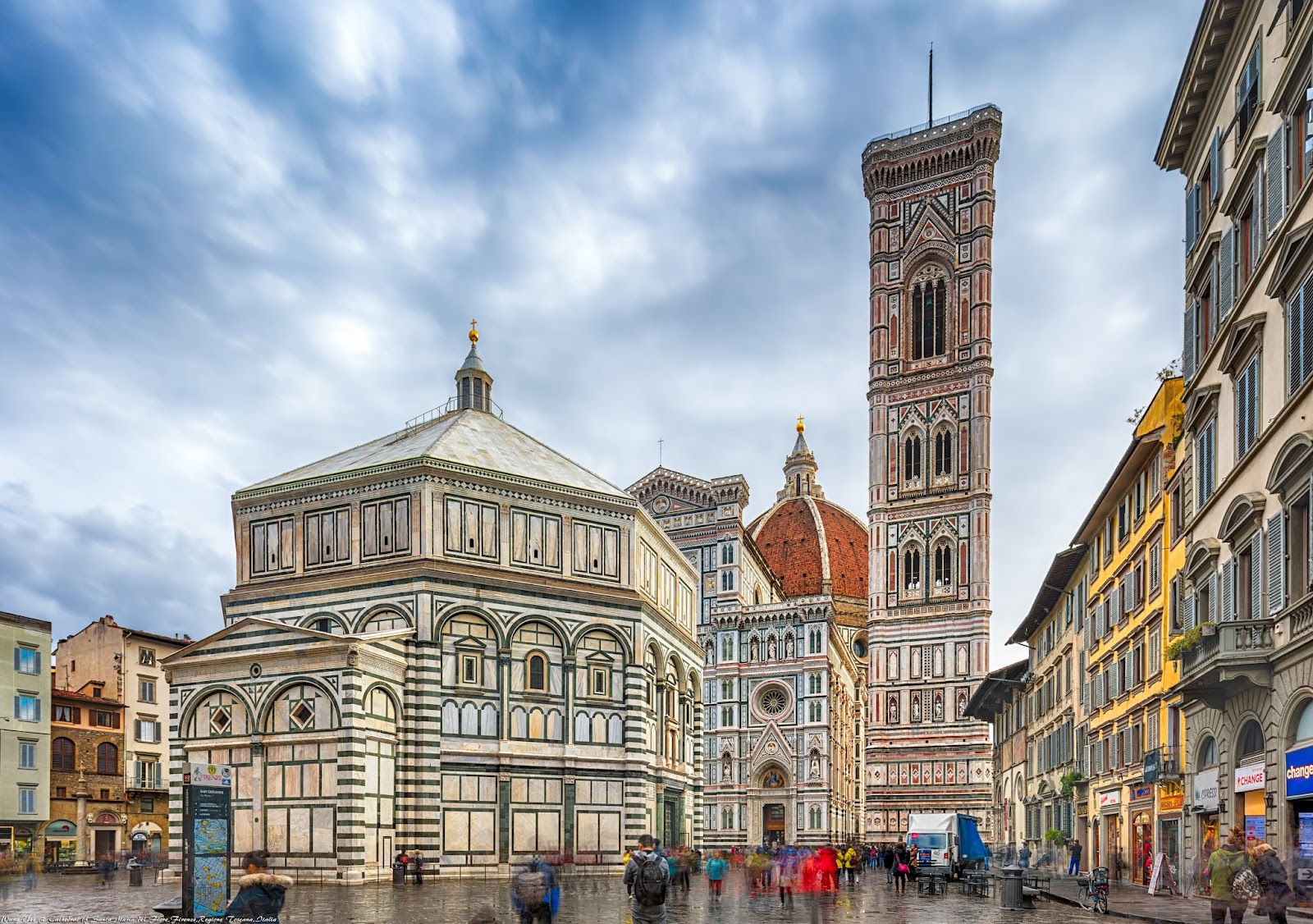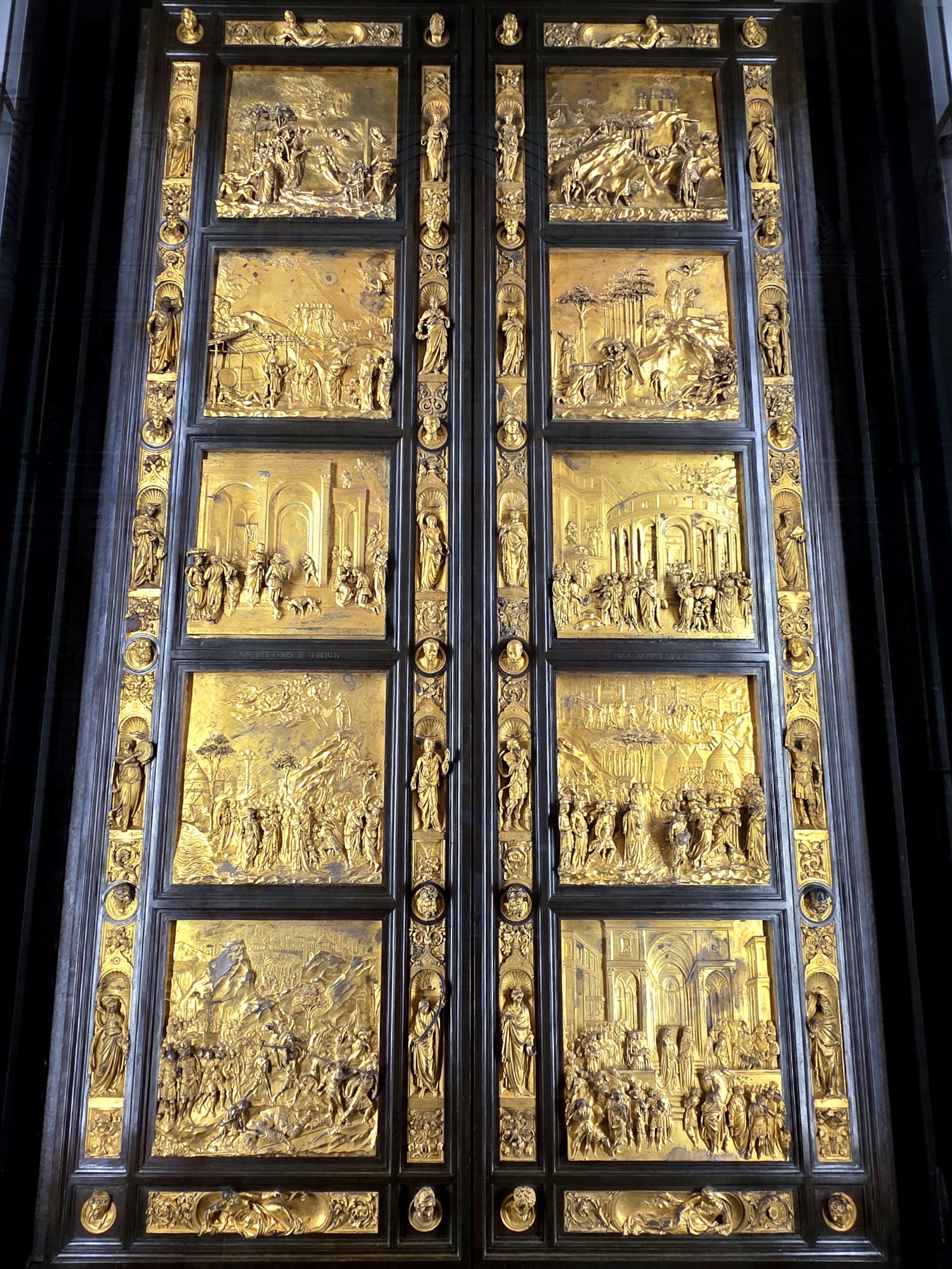
In front of the cathedral stands a smaller, eight-sided building wrapped in the same marble, with a set of doors on this side that look like solid gold. That's the Baptistery, one of the oldest buildings in Florence — so old that medieval Florentines were convinced it had once been a Roman temple. You're here for the doors in a moment. But first, look at the ground you're standing on — something happened on these exact steps that quietly rewired how everyone would see for five hundred years.
This is where Brunelleschi — back from Rome, brain full of ancient geometry — ran the single most important science experiment in the history of art. He painted a small, precise picture of this Baptistery, the building right in front of you, seen from the cathedral doorway. Then he drilled a hole through the back of the panel, at the exact vanishing point. You'd hold the painting face-away, put your eye to the hole from behind, and raise a mirror at arm's length in your other hand — look through t
he peephole into the mirror, and see his painting of the Baptistery; lower the mirror, and see the real Baptistery, same spot, and the two lined up perfectly. Same angles. Same shrinking. Indistinguishable.
That was the proof. He had worked out linear perspective — the mathematics of how parallel lines appear to converge on a single vanishing point as they recede — and demonstrated it, on this sq