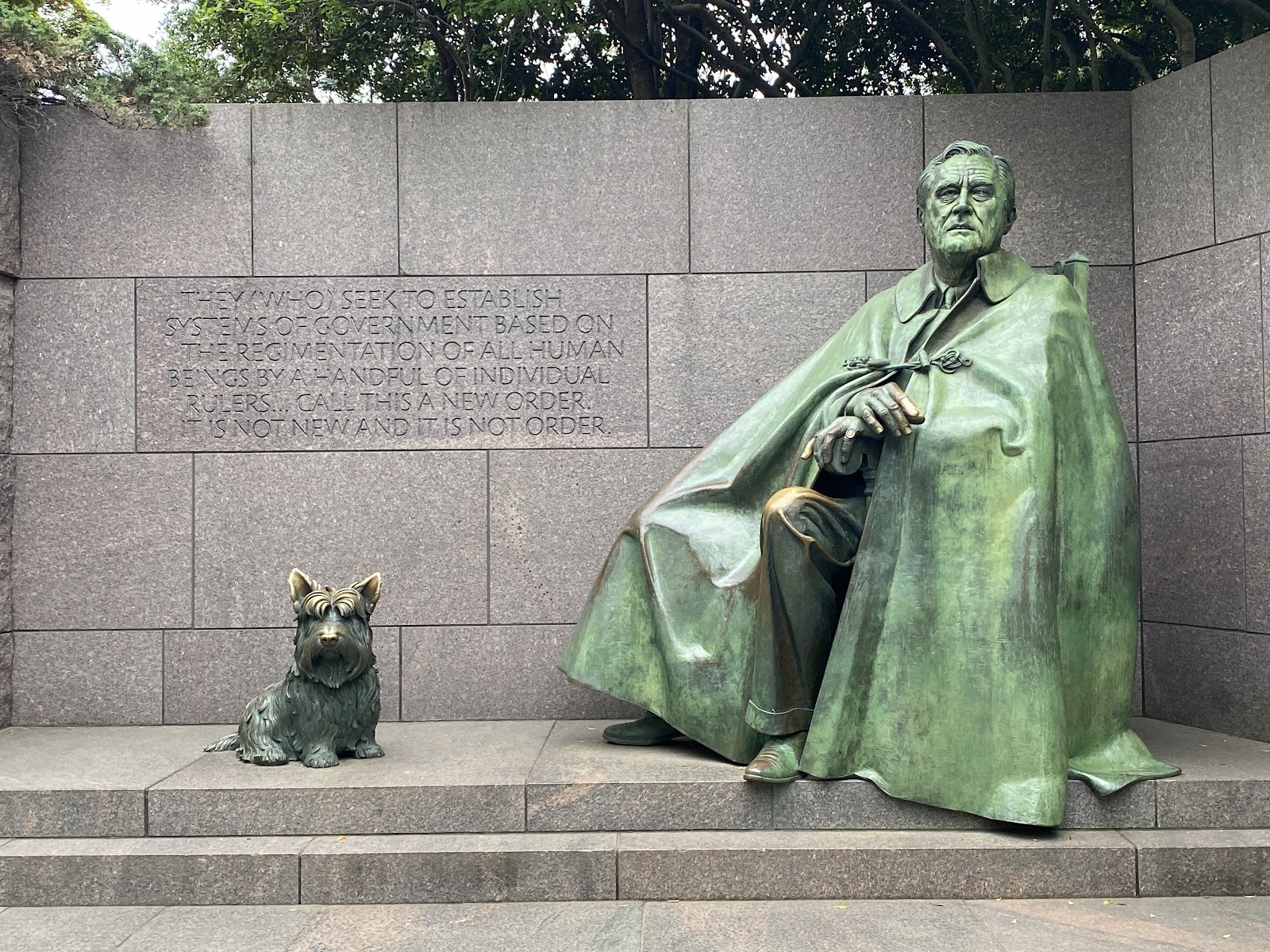
Seven and a half acres. Four outdoor rooms. Waterfalls that get louder as you walk deeper. A bronze breadline. A bronze dog. And all of it built for a man who specifically said — do not build me a monument.
In nineteen forty-one, Roosevelt told his friend Justice Felix Frankfurter exactly what he wanted — a block about the size of a desk, plain, set in front of the National Archives, reading only In Memory Of. And they built that one. In nineteen sixty-five, a small white marble block, three feet tall, was quietly placed on the Archives lawn. Exactly what he asked for.
Then they spent fifty years and a hundred and twenty million dollars building him this.
The memorial is divided into four rooms — one for each of Roosevelt's four terms. And the genius of it is the water.
Room One is a single, quiet stream. Hope. Nineteen thirty-three. The only thing we have to fear is fear itself. Room Two adds a tiered cascade — the New Deal, building infrastructure. Here George Segal sculpted a br
eadline: five men in overcoats waiting for soup. One of the five is Segal himself. Another is Leon Bibel, a former W-P-A artist who had actually stood in Depression breadlines as a young man — the one figure in the sculpture who knew what it felt like.
Room Three. War. Walk into it.
The waterfall goes from tiered to chaotic. Water crashes over broken granite blocks roughly fourteen feet down. Th