The Alfred Caldwell Lily Pool

The Alfred Caldwell Lily Pool

Lincoln Park , Chicago

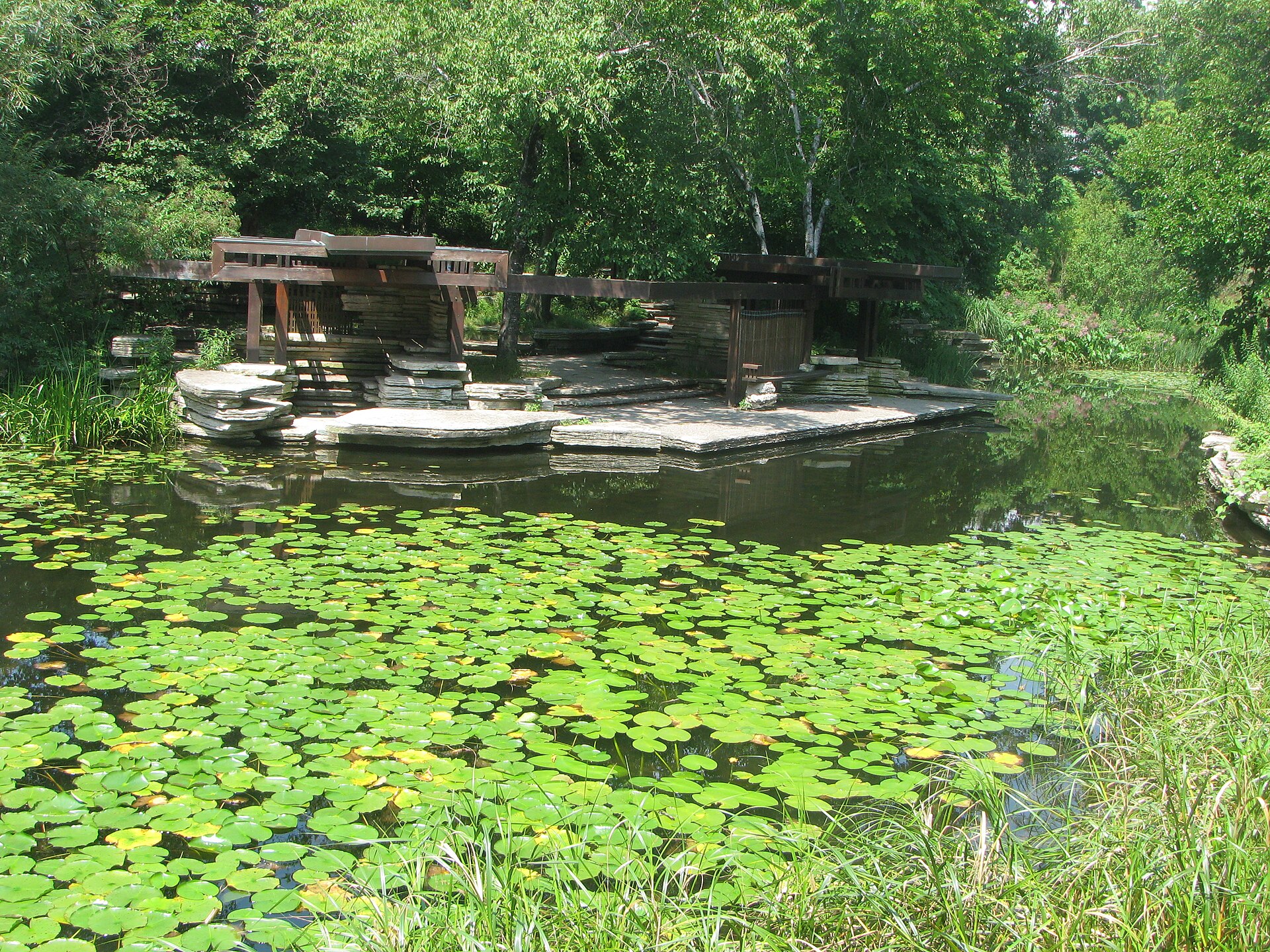
Come through the gate and listen to what happens to the sound. The traffic drops away. That was designed. The stone walls and the tree canopy were shaped to do precisely that.

Come through the gate and listen to what happens to the sound.

The traffic drops away. That was designed. The stone walls and the tree canopy were shaped to do precisely that. It means you can hear moving water in the middle of a city of three million people.

Every stone in here is pretending. The layered limestone along the edges is meant to look like the natural rock ledges of the Midwest, stacked the way moving water stacks them. The pool is shaped like a slow river bend. The waterfall at the top is supposed to read as the river's source. None of this occurs naturally anywhere near Chicago. All of it was built by hand in the nineteen thirties, on top of a failed Victorian lily pond, by Depression relief crews. Men who badly needed the work, spending two years stacking rock into the shape of a river that had never been there.

Up on the rise there's a ring of stone benches. That has a name and an argument behind it. Jens Jensen called it a council ring and built them into parks all

over the Midwest. His theory was that people speak to each other differently when there's a circle and no head of the table.

The man directing them was Alfred Caldwell. He was young, broke, and completely certain. He had trained under Jens Jensen, and he believed — as an actual conviction, not a slogan — that ordinary people in a crowded industrial city were owed a place that felt like open coun
Hear the full story

Hear this story with audio narration in the Bad Historian app.

Get the App

Quick Facts

  • Designed by Alfred Caldwell, built 1936-1938
  • National Historic Landmark (2006)
  • Caldwell cashed in $300 life insurance to buy plants
  • Restored 1998-2002 for $2.4 million
  • Alfred Caldwell built the Lily Pool between 1936 and 1938 with Depression relief crews on top of a failed Victorian lily pond; the limestone ledges and the river form are entirely artificial.
  • The ring of stone benches is a council ring, a form from Caldwell's teacher Jens Jensen, built on the theory that people talk differently in a circle with no head of the table.
  • When the Park District refused to fund the wildflowers, Caldwell cashed in his own life insurance policy — $250 — drove to Wisconsin and bought the plants himself.
  • The zoo turned it into a bird exhibit in the 1950s and it fell derelict; Caldwell, who lived to ninety-five, was alive for all of it.
  • A $2.4 million restoration reopened it in the early 2000s, it became a National Historic Landmark in 2006, and a pavilion rebuild replacing 85% of the white oak timbers reopened in September 2025.
Featured Tour

The Best Free Day in Chicago

10 stops • 1h 15m

View Tour

Location

Free to visit