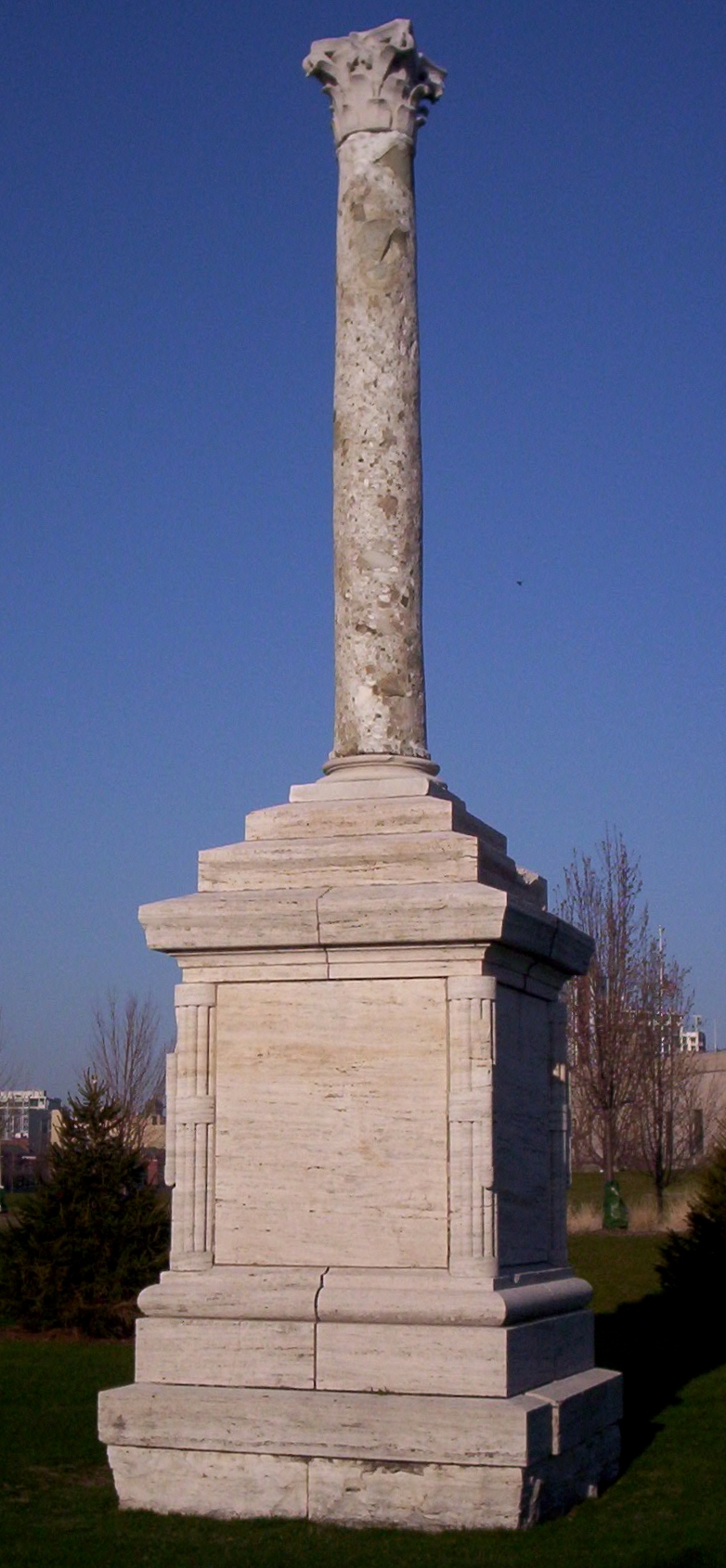
A stone column is standing in the grass beside the lakefront path, greenish, about thirteen feet tall, wearing a plaque nobody reads. It's roughly two thousand years old, it was quarried by Romans, and it is here because of a dictator and a flight of seaplanes.
The column came from Ostia Antica, the ancient port city at the mouth of the Tiber that supplied Rome with its grain. It stood in a portico near the sea gate. It has been holding up nothing at all since sometime in the Roman Empire, and it is now approximately forty feet from a bike lane.
The reason involves one of the strangest afternoons in Chicago's history. On the fifteenth of July, nineteen thirty-three, twenty-four Italian seaplanes came down onto Lake Michigan in formation. All twenty-four at once, together. They had left Rome sixteen days earlier under a general named Italo Balbo. Ninety-six airmen, hopping across Europe, Iceland, Labrador and Canada. They came down beside a World's Fair, in front of a city that had ne
ver seen anything like it. Crossing the Atlantic alone was still front-page news. Crossing it as a squadron and arriving on schedule was science fiction.
Chicago lost its mind. Sixty thousand people packed into Soldier Field to see the crews. The city renamed Seventh Street after Balbo, which is why there's still a Balbo Drive downtown. New York gave him a ticker-tape parade. For a few weeks in n