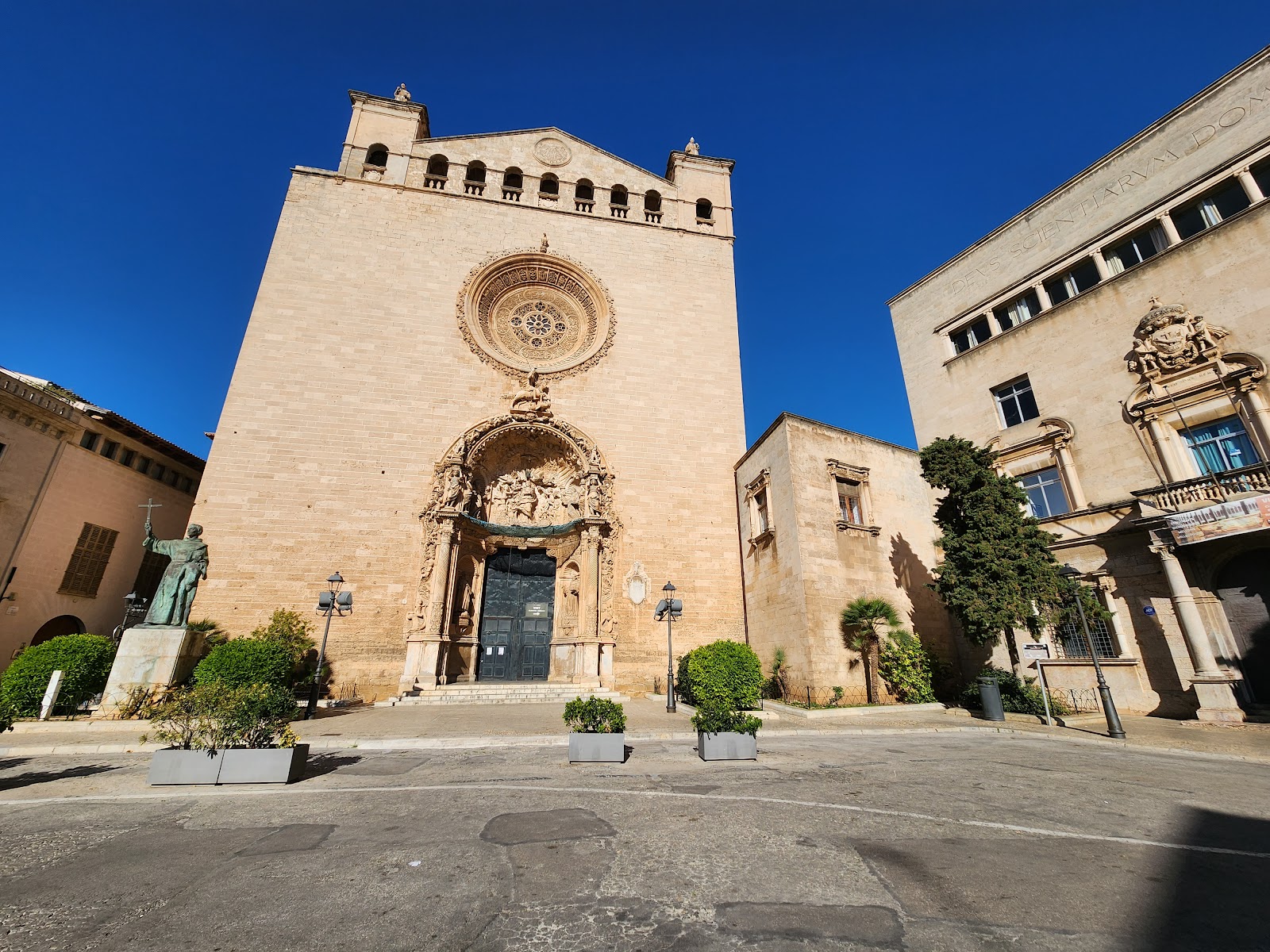
Big square, big Baroque front, one friar standing on a plinth out here in the middle. The friar is Juníper Serra, who left this island and founded the missions that became San Diego and San Francisco — and California has been arguing furiously about his statues ever since.
But the man I want is inside, in a stone box in the first chapel on the left. His name was Ramon Llull, he was born a few streets from here in the thirteenth century, and he tried to build a machine that could prove God.
Not a metaphor. A device.
Llull started out as the least likely candidate imaginable. A rich merchant's son, a courtier, a writer of fairly sweaty love poetry. By his own later account, he once rode a horse into a church, because he was pursuing a woman who had gone in there to get away from him.
Then, in his early thirties, he had a series of visions. He gave away most of what he owned, made provision for his wife and children, and walked out of that life entirely.
And he came back with an idea
that nobody had had before.
Llull's idea was that arguing was inefficient. Two people of good faith disagree about the nature of God, they talk past each other for forty years, and nothing is resolved because human beings are bad at holding many ideas in their heads at once. So he built the thinking part outside the head. He made discs — circles of parchment, one inside another, each ring marked