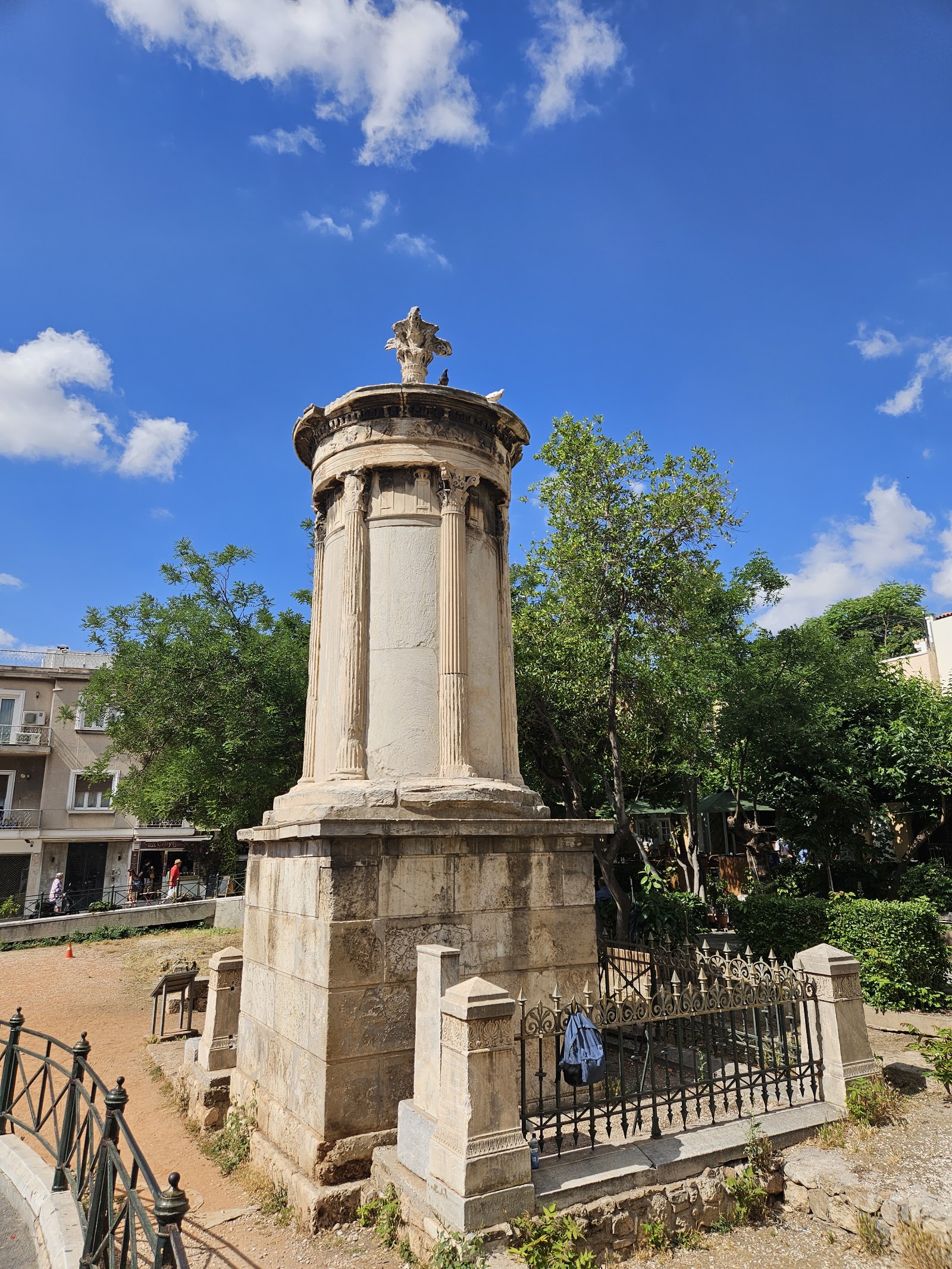
The little round marble building on the square stone base is the Monument of Lysicrates. Get close enough to see the top of it: six slim columns, a carved band running around under the roof, a roof shaped like a cluster of leaves, and right at the peak, an empty stand. Something used to sit up there. That something is why a copy of this building is sitting on top of the Tennessee State Capitol.
Start with the empty stand. Every spring Athens held a festival of theater and music, and one of the contests was for choirs, fifty men or fifty boys, singing and dancing in a circle. Each choir needed a rich sponsor to pay for the training, the costumes and the musicians, and the sponsors competed every bit as hard as the singers.
The prize was a bronze tripod, and you did not take it home and put it on a shelf. You built a monument in the street and set the tripod on top, so the whole city would see it on the way to the theater. This road was lined with them, which is why it's still called T
ripodon, the Street of the Tripods.
In three hundred thirty-four B.C., a wealthy man named Lysicrates sponsored the winning boys' choir. This is his trophy stand. The carved line under the roof says so: his name, the boys, the flute player, the trainer, and the year. It's the only one of the street's trophy stands still standing.
It survived because people kept moving in. Around sixteen sixty-ni