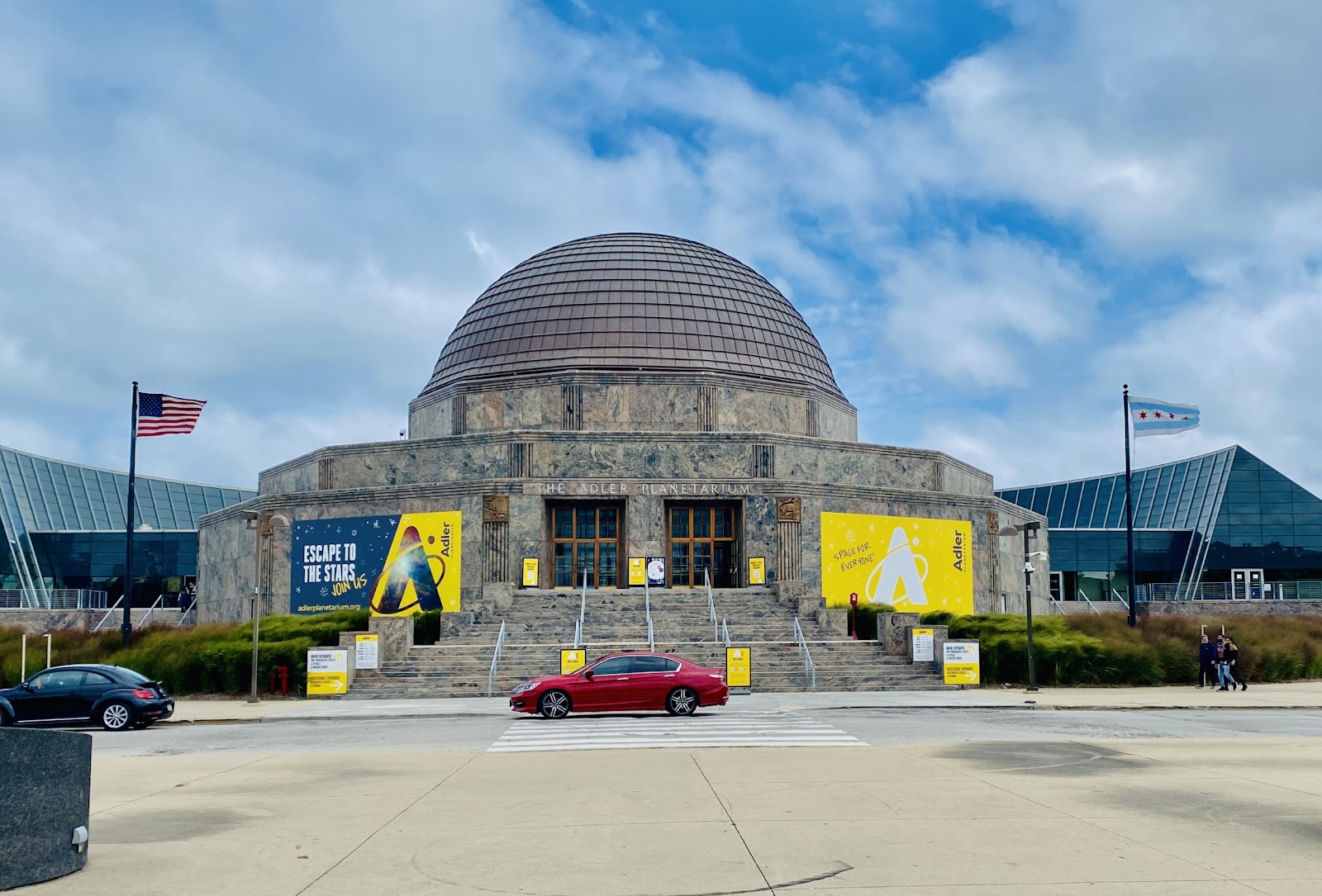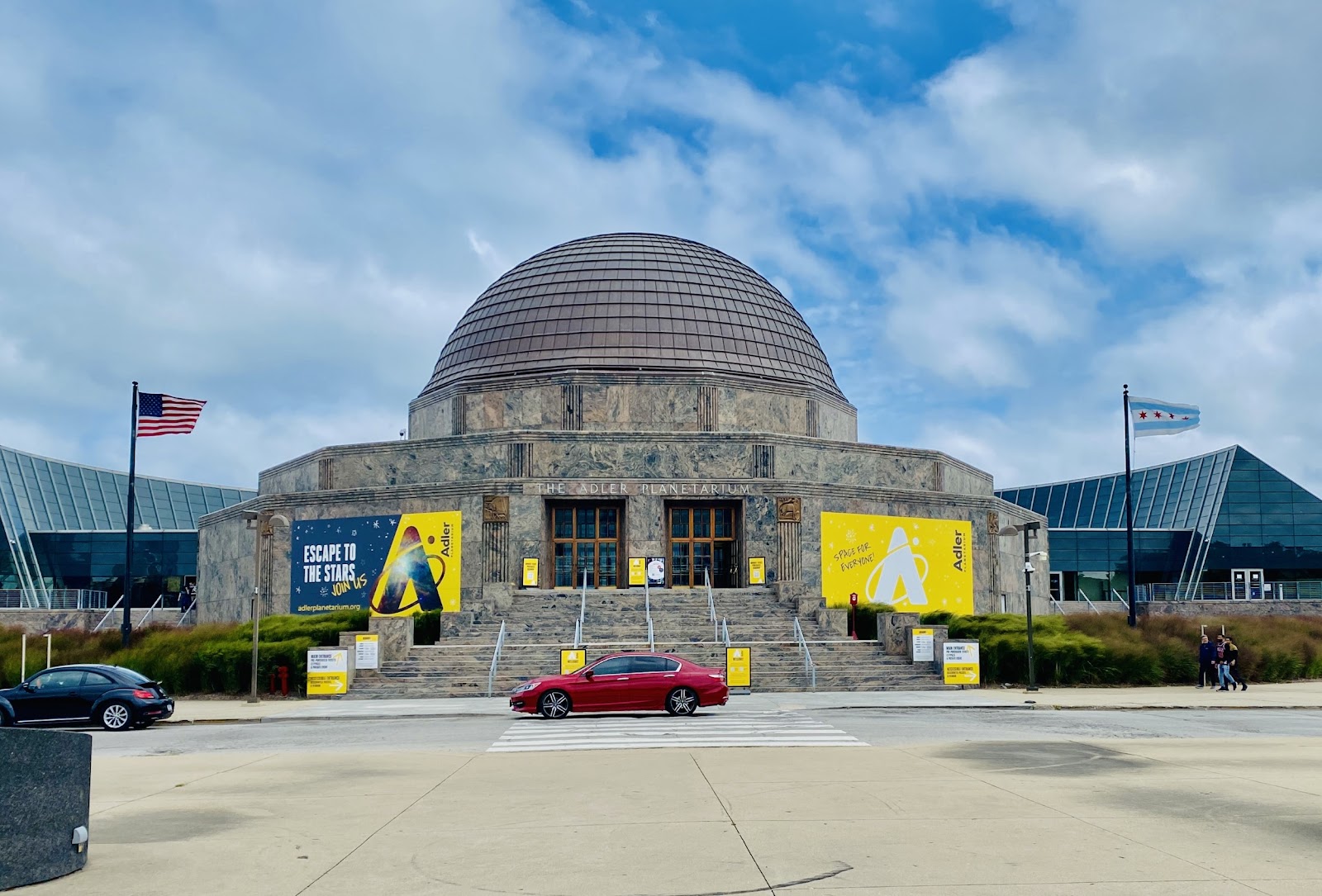
Your brain is going to file the building at the end of this peninsula as a nineteen-thirties idea of a flying saucer. Close enough. It's the Adler Planetarium, and until it opened, nobody in the entire Western Hemisphere had ever sat in a room and watched a machine make a sky.
Count the sides. Twelve. It's a twelve-sided drum of rainbow granite under a copper dome. At each of the twelve corners sits a bronze plaque showing a sign of the zodiac. Alfonso Iannelli sculpted them, they were cast here in Chicago, and they're finished in twenty-two-karat gold. Architect Ernest Grunsfeld built a calendar and then put an observatory inside it. The Chicago architects' association gave him a gold medal for it, and they were right to.
The man who paid was Max Adler, a trained violinist who somehow ended up as an executive at Sears, Roebuck and Company. He retired early, wealthy, and went traveling. In Munich he walked into a dark room where a machine called a Zeiss projector was throwing stars o
nto a curved ceiling. He came home convinced that America was owed one of these, and put up five hundred thousand dollars to build the room to hold it.
Understand what that projector could actually do in nineteen twenty-eight. No satellites. No space photography. Nobody alive had seen Earth from outside. And this machine, a lens-covered thing the size of a small car, could show you the exact sky