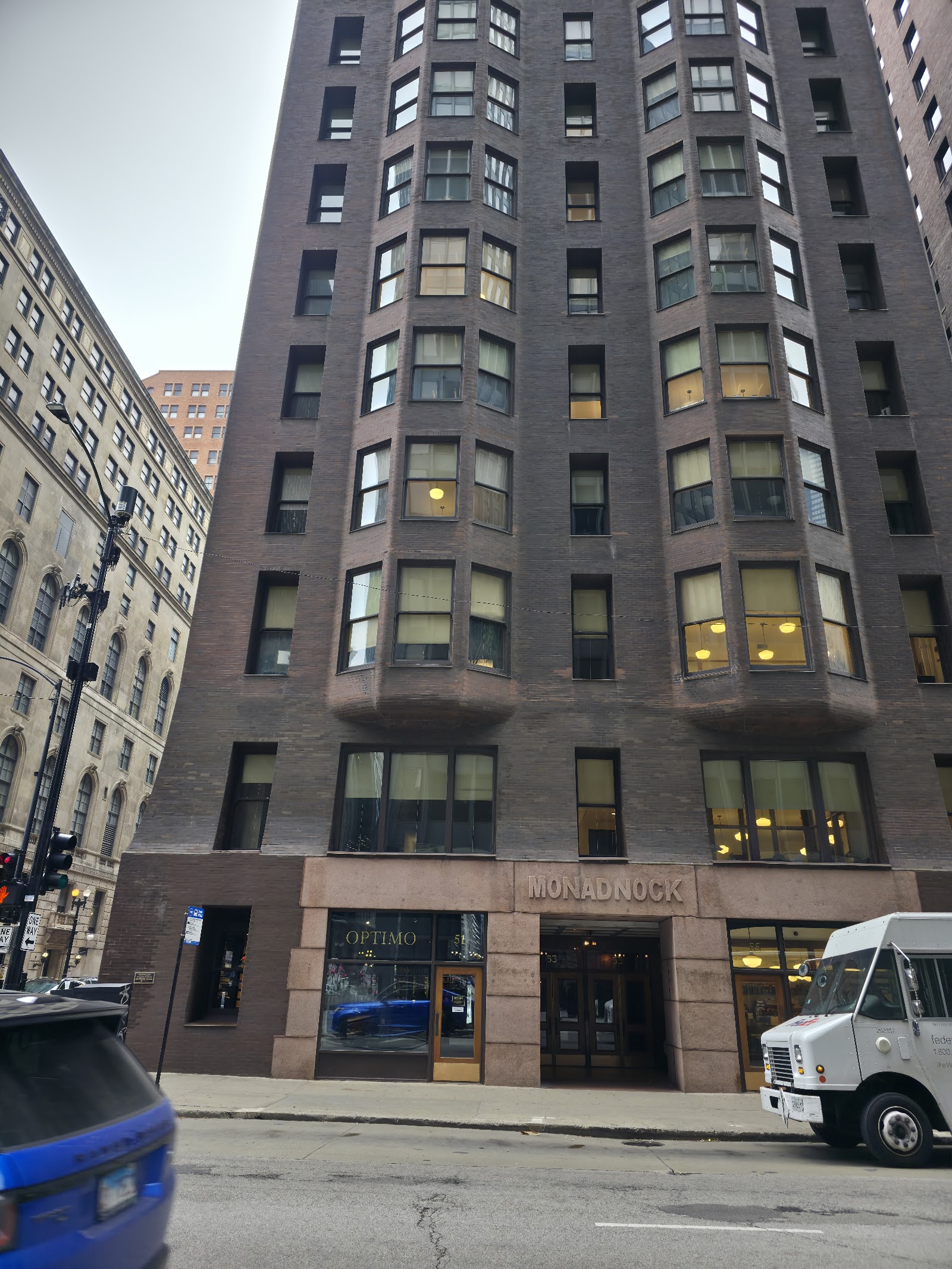
The long dark brown slab in front of you is the Monadnock Building, and it has the visual charisma of a very serious brick. I mean that with real affection. It might be the most consequential brick anyone ever laid.
There is no ornament on it. None. No carved swags, no columns, no cherubs, no cornice fussing around the top — just a flat purple-brown wall of brick going up and up with rows of bay windows pushed out of it. That was the client's demand. The Monadnock was built for two Boston property investors, Peter and Shepherd Brooks, who wanted a building with nothing sticking out of it, on the grounds that everything that sticks out of a Chicago building collects soot and costs money to clean. They ordered the decoration removed for maintenance reasons. What they got, by accident, was one of the first modern buildings on Earth — sixty years before anybody was ready for it.
John Root, who designed it, took that constraint and did something quietly magnificent with the only tool left
to him, which was the shape of the wall itself. The base flares out at the sidewalk. The top curves gently outward again, like a papyrus stalk opening. There's no decoration anywhere, so the whole building is doing its expression through a slight swell in a brick surface. He nicknamed it his Jumbo. The name came from the clients' habit of calling their buildings after New England mountains. And a