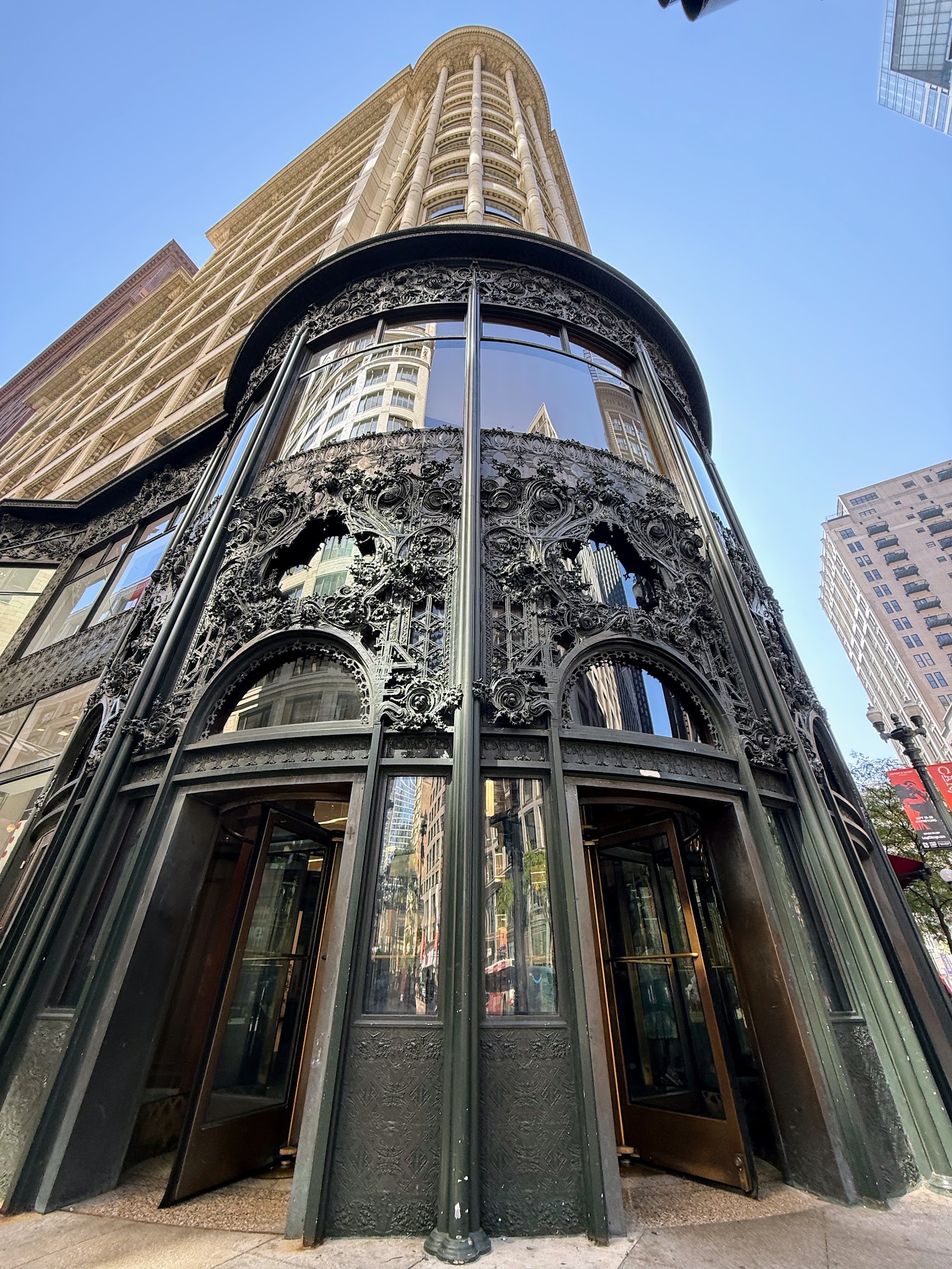
Get close to the rounded corner where State Street meets Madison, and look at the metal around the doorway. It runs from the entrance up through two full floors, and it's the finest metalwork in Chicago. Cast iron, and a jungle — vines, seed pods, curling leaves, hexagons and spirals folding into each other so densely that your eye can't find where one shape ends. Every one of those forms was drawn from the plants that grow on the prairie outside this city, and a workshop spent well over a year modeling and casting it, piece by piece, before it ever went on the wall.
The man who designed it is Louis Sullivan, and he is the most important architect on this walk and the name fewest people recognize.
Look above the entrance and hunt for letters hidden in the leaves. Worked into that ornament are the initials L-H-S — Louis Henri Sullivan — and beside them, S-M, for Schlesinger and Mayer, the department store that commissioned the building. He signed his masterpiece the way a mason signs
a cornice: in the metal, at the entrance, in plain sight, where a hundred thousand people a day would walk past and never look up.
Look up anyway, because above all that ornament the building does something stranger by being plain. Wide horizontal windows in a clean grid, floor after floor, the frame barely dressed at all. Sullivan's argument was that a steel building should stop pretending to be