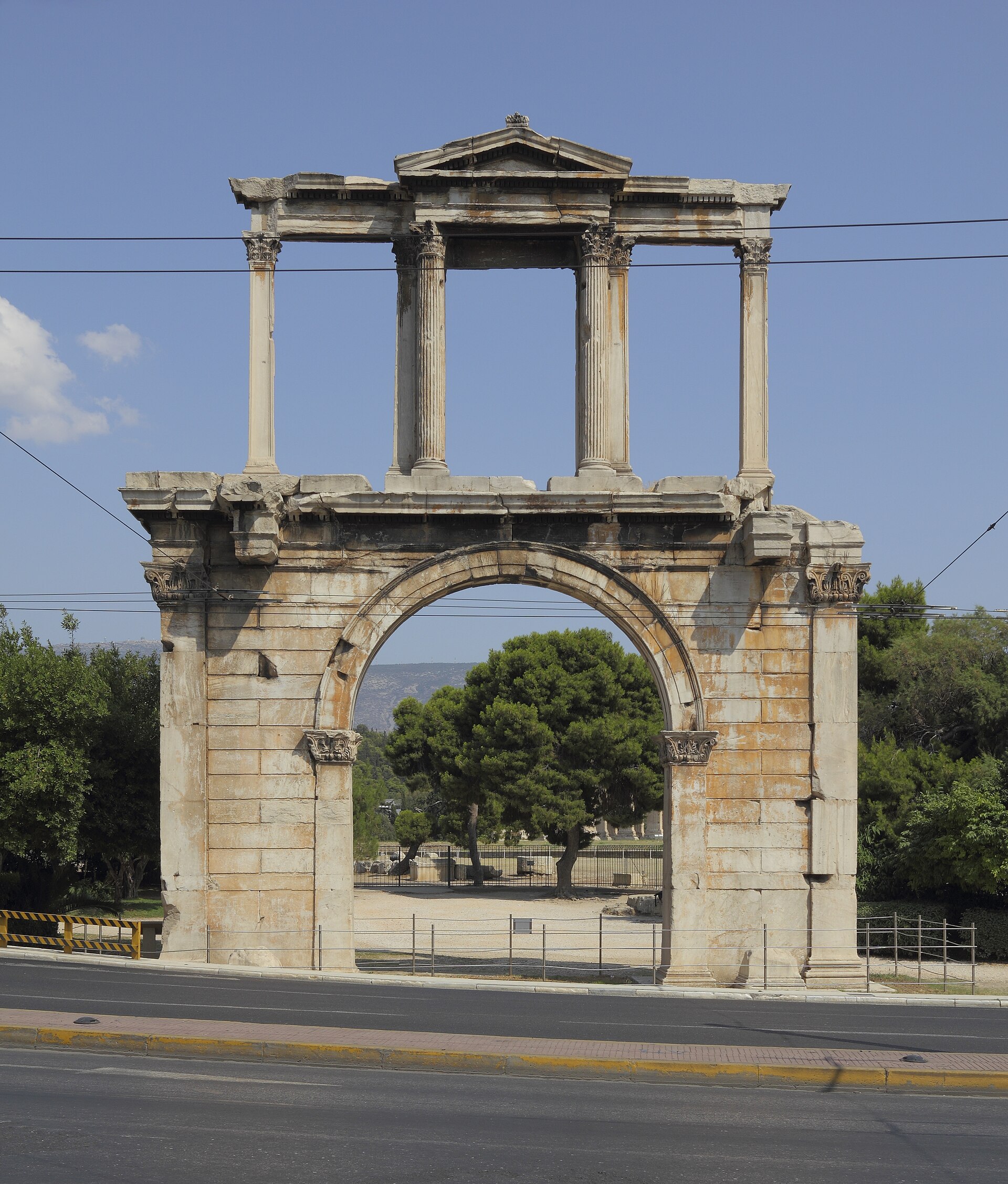
The tall marble gateway standing by itself beside the avenue is the Arch of Hadrian. It's a gate with no wall, with nothing on either side of it but traffic and air. Above the opening, on both faces, a line of Greek letters runs across the stone. Those two lines are the reason to stop, because this arch argues with itself.
Hadrian was the Roman emperor in the early hundreds A.D., and he was in love with Greece, more than Rome found entirely comfortable. As a young man he was so hooked on Greek books and Greek ideas that people in Rome called him Graeculus, the little Greek. He grew a full Greek-style beard, the first emperor to wear one, and the emperors after him copied it for the next century and a half.
Long before he took the throne, Athens made him a citizen and elected him its chief magistrate. As emperor he came back three times and spent a fortune. He gave the city a library, an aqueduct, a whole new neighborhood, and he finished the colossal temple behind this arch, which th
e Athenians had given up on six hundred years earlier.
Around the year one thirty-one, the Athenians put up this arch on the line between their old city and Hadrian's new district. On the side facing the Acropolis, the inscription says: This is Athens, the ancient city of Theseus. Theseus was the legendary king who founded Athens. On the far side, facing the new district and the temple, it says: