Bateau-Lavoir (Picasso's Studio)

Bateau-Lavoir (Picasso's Studio)

Paris, France

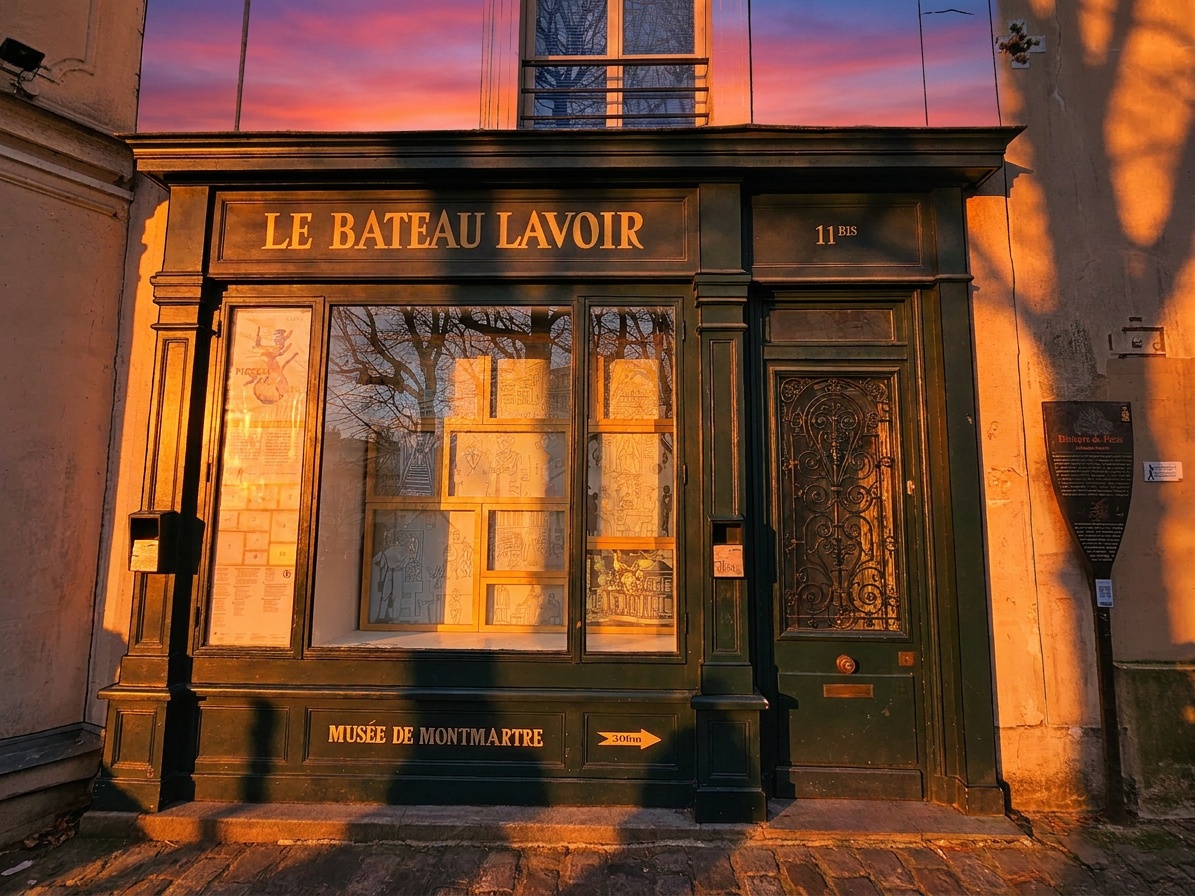
This quiet little square — Place Emile-Goudeau — is where modern art was born. In a building that had one water tap and no toilet. The Bateau-Lavoir was a ramshackle wooden structure — a former piano factory, leaning into the hillside.

This quiet little square — Place Emile-Goudeau — is where modern art was born. In a building that had one water tap and no toilet.

The Bateau-Lavoir was a ramshackle wooden structure — a former piano factory, leaning into the hillside. The poet Max Jacob gave it the name. He said it reminded him of the flat-bottomed laundry boats on the Seine, because the whole building creaked in the wind, laundry hung from every window, and everyone shared a single tap on the ground floor. Like going to the river.

Here's the disorienting part — because the building was built into the slope, you entered from the street at the TOP floor. The studios went DOWN. So you'd walk in off the square feeling like you were on solid ground, and then descend into a warren of cold, dark, paint-soaked rooms.

Picasso moved in at twenty-three, in nineteen oh-four. His studio was filthy, chaotic, freezing in winter, suffocating in summer. His girlfriend Fernande Olivier described it in her memoir — canvases piled ev

erywhere, a pet mouse he kept in a drawer, a rusty stove, a yellow bowl for washing. And a smell of paint and dog. He had a dog named Frika. She had a mouse in a drawer.

Picasso worked by candlelight, mostly at night. And in nineteen oh-seven, in this building, on a canvas eight feet by seven — which basically filled the entire studio — he painted Les Demoiselles d'Avignon. Five fractured figures
Hear the full story

Hear this story with audio narration in the Bad Historian app.

Get the App

Quick Facts

  • The Bateau-Lavoir was a ramshackle former piano factory with one water tap and no toilet, named by poet Max Jacob
  • Picasso moved in at 23 in 1904 and painted Les Demoiselles d'Avignon here in 1907, on an 8x7 foot canvas that filled the studio
  • His friends' first reactions were harsh — Braque said it felt like drinking petrol and spitting fire; Derain said Picasso would be found hanged behind his canvas
  • The painting wasn't publicly shown until 1916 and wasn't widely exhibited until 1937
  • Max Jacob, the poet who named the building and was Picasso's close friend, died at the Drancy internment camp in 1944
  • In 1908 Picasso threw a chaotic banquet for painter Henri Rousseau, with Marie Laurencin falling into pastries and candle wax dripping on Rousseau's head
  • The original building burned down May 12, 1970; the current structure is a 1978 reconstruction still used as artists' studios
Featured Tour

Montmartre: Geniuses, Gluttons & Goats

9 stops • 49 min

View Tour

Location

Paris, France
Open in Maps