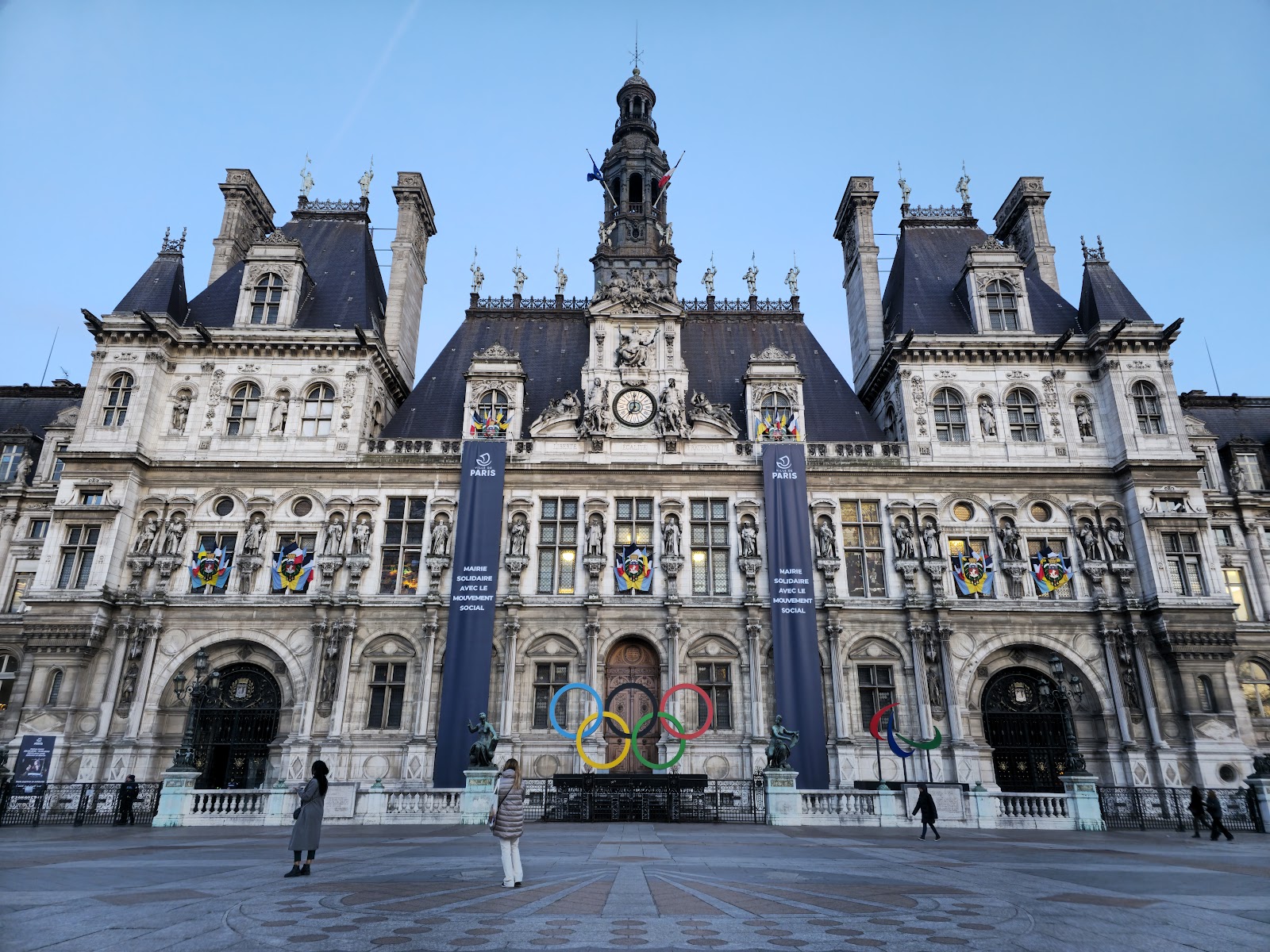
Hôtel de Ville

Hôtel de Ville

Paris, France

The enormous wedding cake of a building in front of you is the Hotel de Ville — the city hall of Paris. The city has been governed from this exact spot since thirteen fifty-seven.

The enormous wedding cake of a building in front of you is the Hotel de Ville — the city hall of Paris. The city has been governed from this exact spot since thirteen fifty-seven. Nearly seven hundred years of mayors, uprisings, and municipal paperwork, all administered from one riverside address. And that river is the reason you know a very useful French word.

Before this was a grand square, it was a gravel beach sloping down to the Seine — in old French, a greve. It was the city's unloading dock, so men who needed work came and stood on the gravel, waiting to be hired to haul cargo. Going to the greve — faire greve — meant looking for a job. Then, in the eighteen hundreds, workers began gathering on the same square for the opposite reason — to refuse to work until pay improved. The phrase flipped, and faire greve came to mean going on strike. It still does. Every French strike since — every frozen train line, every quiet airport — is named after the beach in front of city hall. Fran

ce walks off the job in the vocabulary of this square, and France maintains a healthy schedule.

The building behind it has burned with the city's temper. In May of eighteen seventy-one, as the Paris Commune collapsed, the Communards torched the Hotel de Ville rather than surrender it. The fire took more than the building. The city's archives were stored here, and they burned — the registers of ev
Hear the full story

Hear this story with audio narration in the Bad Historian app.

Get the App

Quick Facts

  • Paris has been governed from the Hôtel de Ville site since 1357
  • The square was once a gravel beach — a grève — where job-seekers waited to be hired; "faire grève" flipped in the 1800s from looking for work to going on strike, and every French strike is still named after this beach
  • The Communards burned the Hôtel de Ville in May 1871 rather than surrender it, destroying the city archives — every register of birth, marriage, and death back to the 1500s
  • People tracing Parisian ancestors still hit a wall at 1860; clerks spent decades begging families for copies and rebuilt barely a third of the records
  • The hall was rebuilt in under a decade with more than 100 statues of famous Parisians in its facades; one was carved by a young Auguste Rodin
  • Above the central clock is the city's coat of arms — a ship on a rough sea — with the motto Fluctuat nec mergitur: she is tossed by the waves, but she does not sink
Featured Tour

Le Marais: Mansions, Masterpieces & the Best Falafel in Europe

9 stops • 33 min

View Tour

Location

Paris, France
Open in Maps