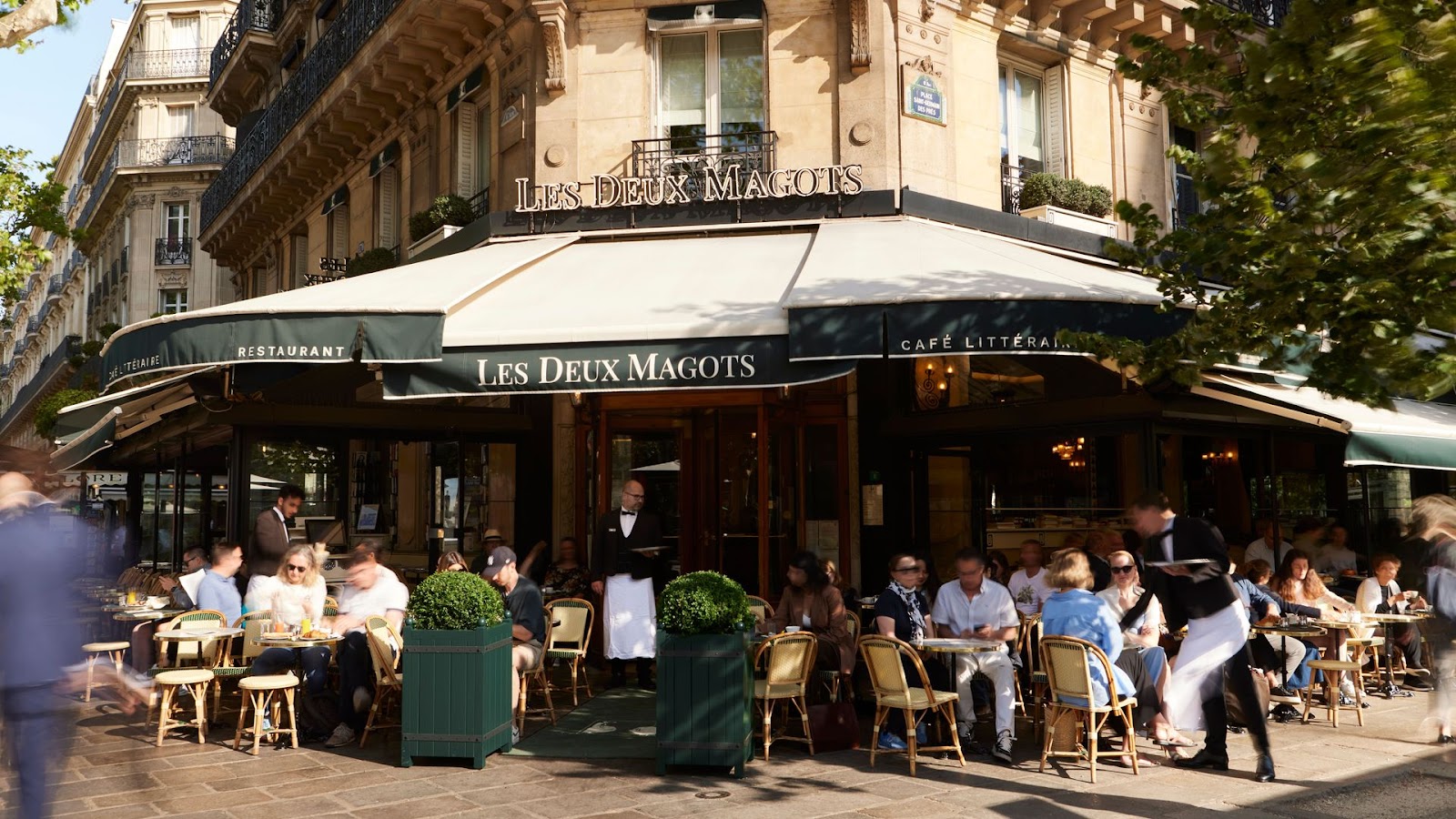
Two cafés, fifty meters apart. Les Deux Magots — say it Lay Duh Mah-goh — sits on the corner facing the old church. Café de Flore is just up the boulevard, under the white awning. Between them, these two rooms have hosted more famous arguments than most parliaments.
Start with the name. Deux Magots means two figurines. This building began as a fabric shop, named after a hit play about China. When it turned into a café, the owners kept the shop's two wooden Chinese statues. They're still inside, mounted on the center pillar, watching the room. Picasso sat under them. Hemingway sat under them. The surrealists held meetings under them. Two carved merchants from a silk shop, presiding over a century of French thought.
But the real story on this corner is heat.
In nineteen thirty-nine, a man named Paul Boubal bought the Café de Flore and installed a big charcoal stove. Then the war came, the Germans occupied Paris, and coal all but vanished from the city. Apartments froze. And the Flore,
because Boubal kept that stove fed, became one of the warmest public rooms on the Left Bank. Put your hand on a marble tabletop here — cold, in every season. During the occupation, that marble was the best heating some people had.
Which is how a café became the headquarters of French philosophy. Jean-Paul Sartre and Simone de Beauvoir — Boh-vwahr — moved in like tenants. Sartre described the sch