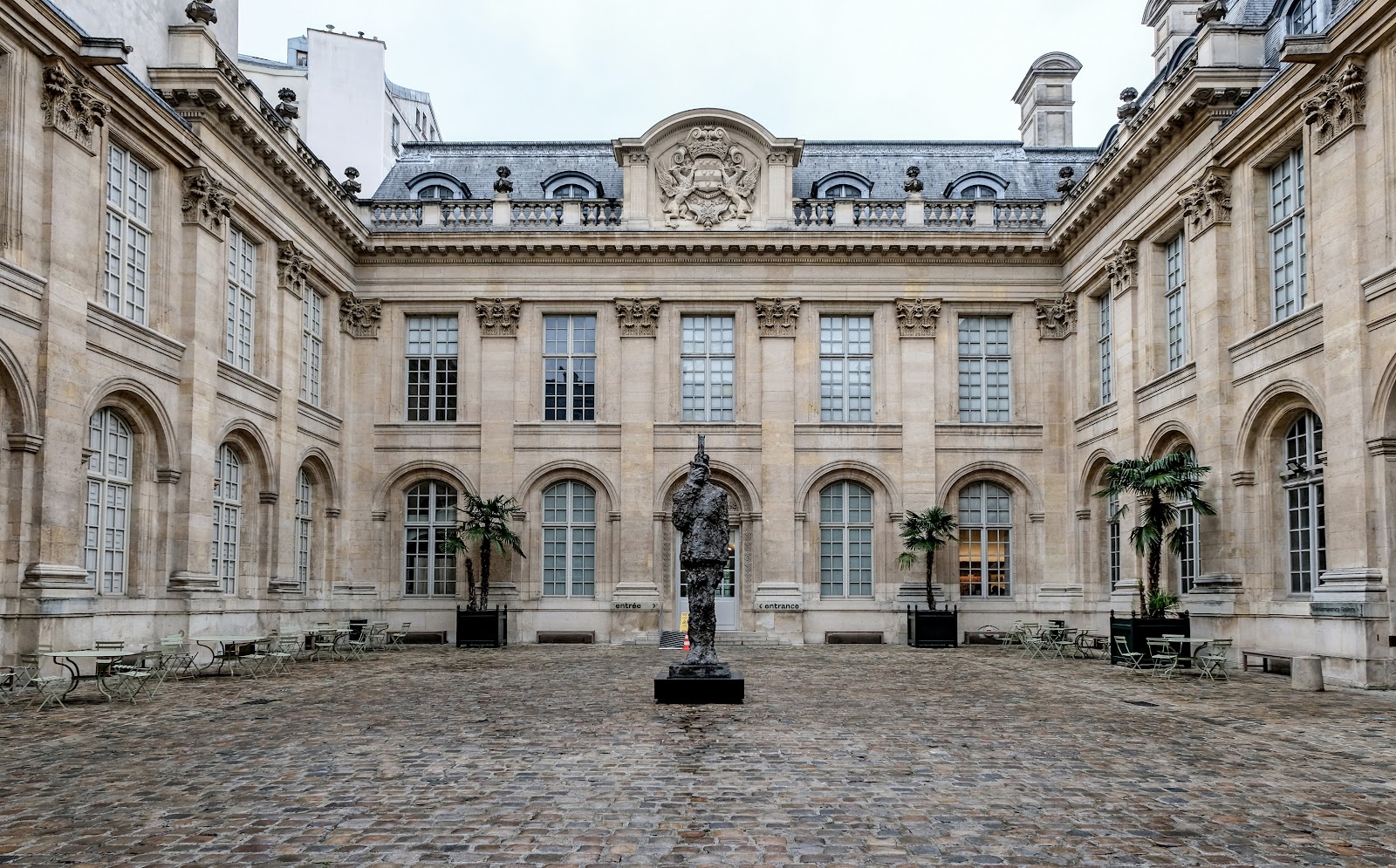
The great carriage door at seventy-one Rue du Temple hides one of the finest mansions in the Marais. The mansion, in turn, is hiding something of its own. This is the Hotel de Saint-Aignan, built in the sixteen forties for the Count d'Avaux. He was the diplomat who helped negotiate the treaty that ended the Thirty Years' War. A man who spent his career making things look settled, living in a house built on the same principle.
Because inside that courtyard, one entire wing of the mansion is fake. When the architect laid out the court, a leftover chunk of Paris's medieval city wall stood in the way. There was no room to build the matching wing that symmetry demanded. So he built the FRONT of one. A full facade — windows, cornices, pilasters, everything — carved in relief against a blank wall, with nothing behind it. French architects have a name for the trick. A fox wall. The count went further and had real flues run up behind it, so the chimneys of his imaginary wing could smoke when h
e entertained. For nearly four hundred years, first-time visitors have looked at that wall and seen rooms that were never there.
When the aristocracy drifted off to Versailles, the mansion began a long slide downhill. By the eighteen hundreds it had been carved into dozens of small workshops and apartments. The people who filled them were Jewish immigrants from Eastern Europe — tailors, cap maker