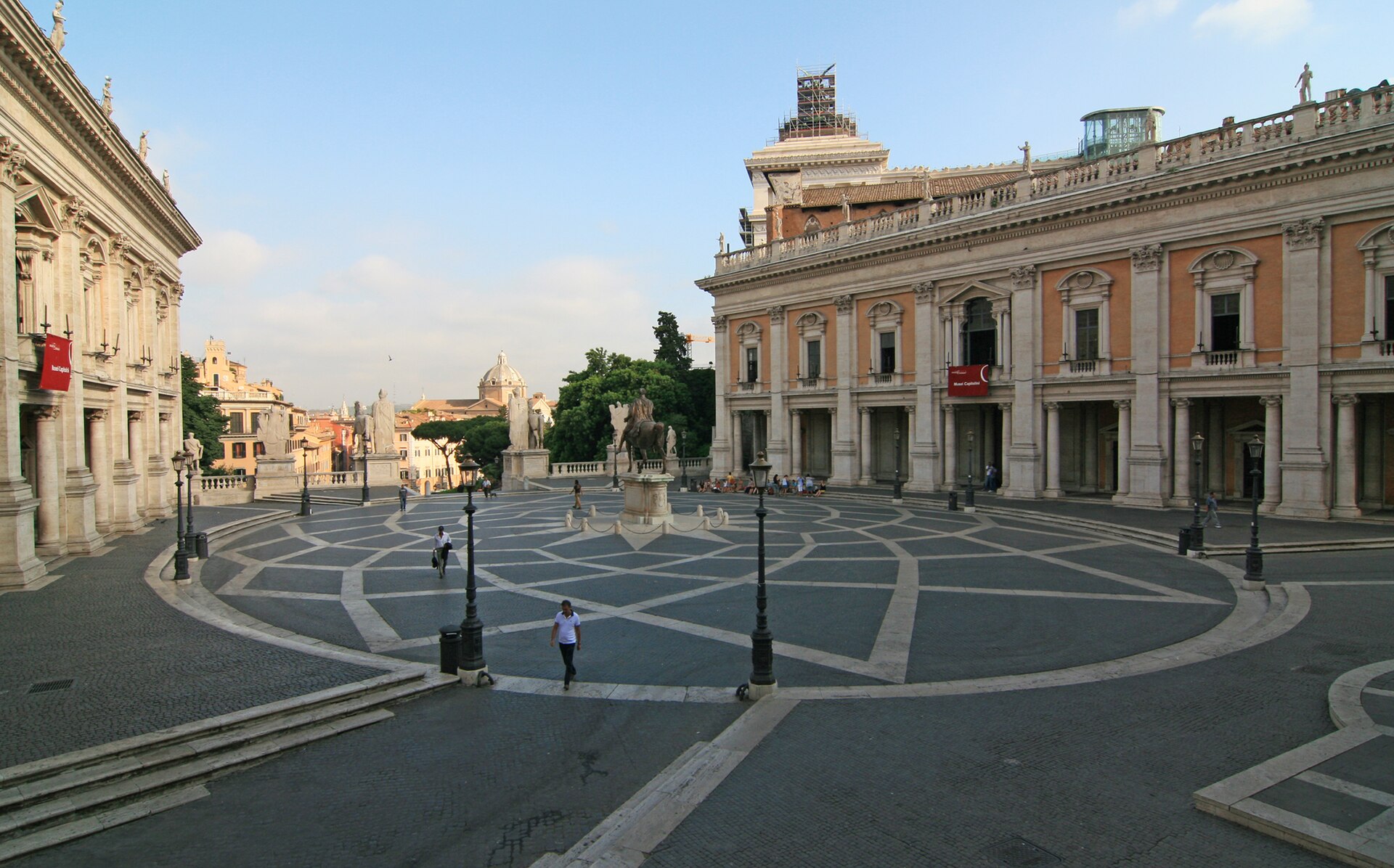
You've walked up onto the Capitoline Hill, into a beautiful open square with matching palaces on three sides and a swirling star pattern set into the pavement. This is the Piazza del Campidoglio, and Michelangelo designed the whole thing. If the layout looks familiar, it might be because it's on the Italian fifty-cent euro coin. You may have his masterpiece in your pocket right now.
The gentle ramp you came up, the Cordonata, Michelangelo designed deliberately shallow so you could ride a horse straight to the top. The palaces around you hold the Capitoline Museums — which have a decent claim to being the oldest public museum on Earth, opened to ordinary people back in fourteen seventy-one. Inside sits the bronze she-wolf that's been the symbol of Rome for over two thousand years, twins and all. And one of the buildings is still Rome's actual working city hall. The mayor governs the modern city from the hill the ancient Romans considered the most sacred ground on Earth. The commute has
not changed in two and a half thousand years.
Two things this hill handed the whole world. Up here stood the Temple of Juno Moneta, and Rome minted its coins right next to it — which is the entire reason we have the words money and mint. They both come from Moneta, a goddess who lived on this rock. And on the far edge is the Tarpeian Rock, a cliff where Rome hurled traitors to their deaths. It s