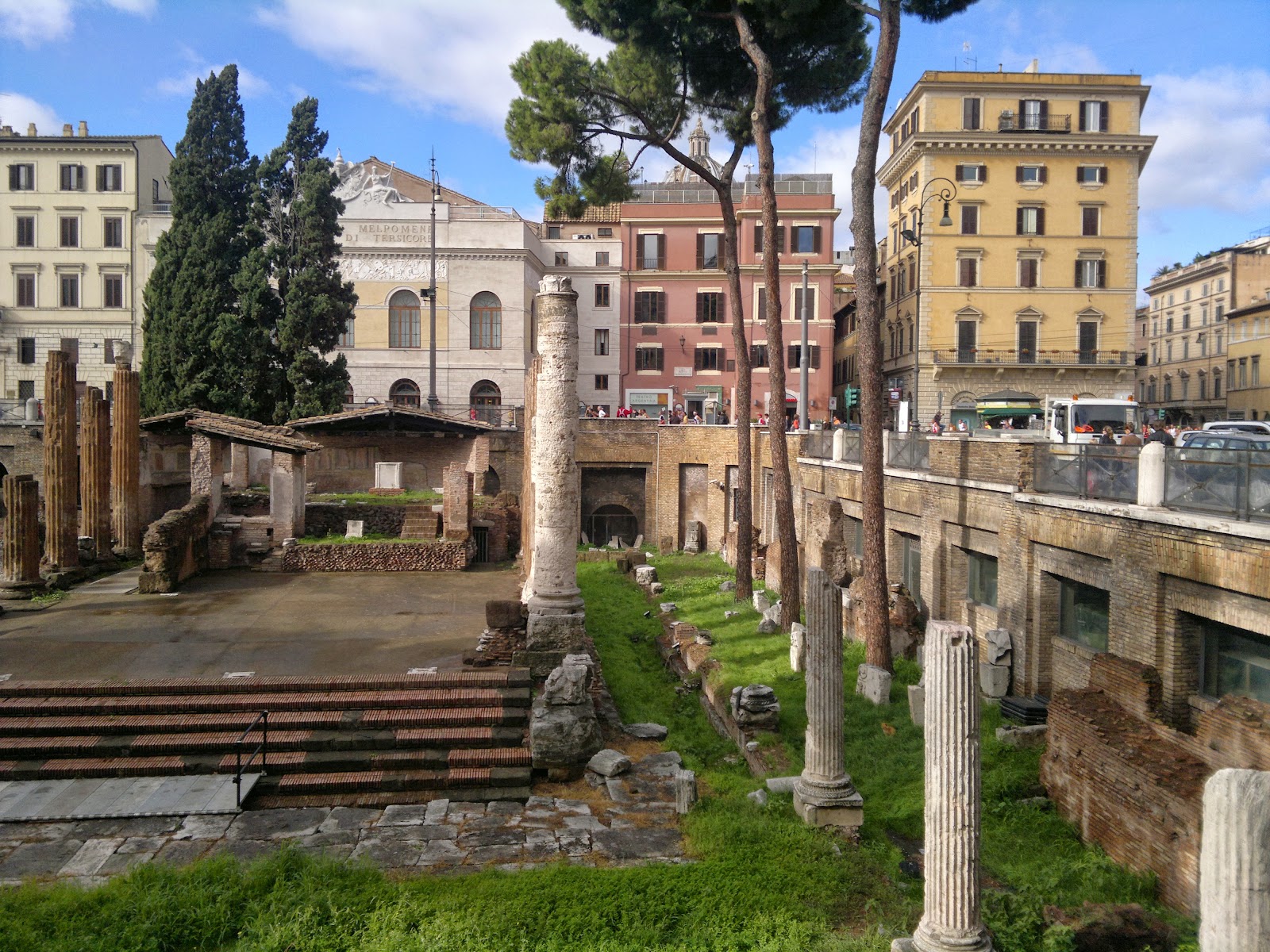
You're looking down into a sunken square full of broken columns and temple ruins, a few meters below the modern street. And if you watch for a moment, you'll notice the residents. Cats. Dozens of them, sunning themselves on two-thousand-year-old marble. This is the most important murder scene in history, and it is run by cats.
Everyone pictures Julius Caesar dying in the Senate — some grand marble chamber in the Forum. He didn't. On the fifteenth of March, forty-four B-C, the Senate was temporarily meeting in a hall attached to a theater complex built by his rival Pompey. That hall stood right here. This is the actual spot. Caesar was stabbed twenty-three times at the foot of a statue of Pompey — the man he had beaten in a civil war — so his old enemy got to watch, in marble, from above.
Those four temple platforms down there are some of the oldest sacred buildings in the whole city — a few of them going back around twenty-three hundred years. Nobody knew they were here until the nin
eteen-twenties, when Mussolini's crews, clearing the block for new construction, hit ancient stone and uncovered the entire complex, including a colossal marble statue so big that only the head and one arm survived. The theater attached to it belonged to Pompey, the first permanent stone theater in Rome. And Pompey built it with a gloriously Roman trick: there was a ban on permanent theaters, so h