Moulin Rouge

Moulin Rouge

Paris, France

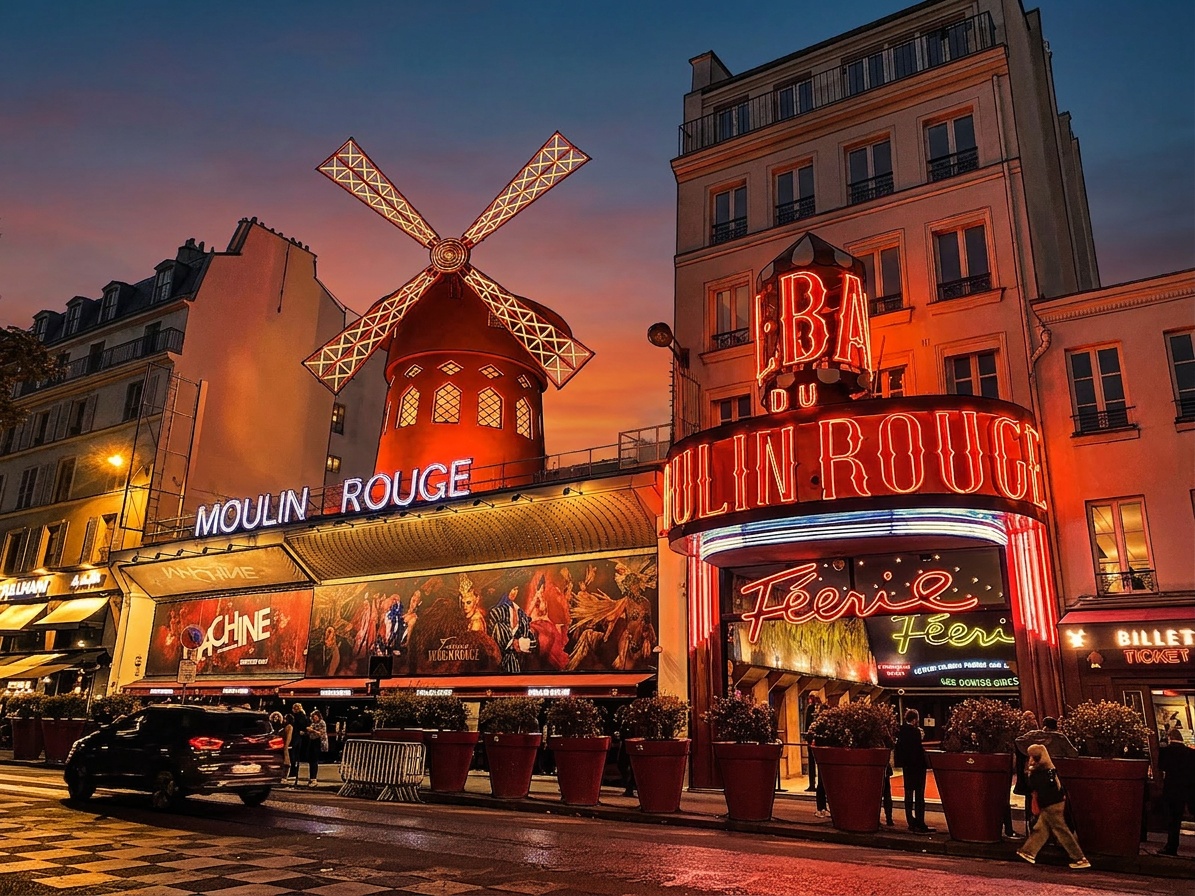
That red windmill. Eighty-two Boulevard de Clichy. It opened on October fifth, eighteen eighty-nine — the same year as the Eiffel Tower. Paris was in shock-the-world mode, and this was its contribution to nightlife. Two men built it.

That red windmill. Eighty-two Boulevard de Clichy. It opened on October fifth, eighteen eighty-nine — the same year as the Eiffel Tower. Paris was in shock-the-world mode, and this was its contribution to nightlife.

Two men built it. Joseph Oller — a Spanish-born entrepreneur who had already invented the pari-mutuel betting system, which is the basis of all modern horse-race gambling. And Charles Zidler — a big, red-bearded showman who knew how to work a room. Together they built a dance hall, multiple bars, a garden — and in the garden, they installed a giant stucco elephant purchased from the World's Fair. The elephant was enormous. You could fit a small room inside its belly. And inside that belly, for men willing to pay extra, there were private belly-dancing performances. A secret show inside a fake elephant in the backyard of a cabaret. Eighteen eighty-nine.

The main attraction was the can-can. And the original was nothing like the chorus-line kick you've seen in movies. The or

iginal can-can was filthy. Dancers wore open drawers — or sometimes nothing underneath at all — and the high kicks were designed to flash the audience. Police were regularly sent to monitor the performances. The word can-can likely comes from the French for scandal.

And the biggest scandal of all was a woman named Louise Weber. Her stage name was La Goulue — the Glutton. She earned it as a teenag
Hear the full story

Hear this story with audio narration in the Bad Historian app.

Get the App

Quick Facts

  • The Moulin Rouge opened October 5, 1889, built by Joseph Oller and Charles Zidler, with a giant stucco elephant in the garden housing private belly-dancing shows
  • The original can-can was scandalous, with dancers' open drawers designed to flash the audience; police regularly monitored performances
  • Louise Weber, stage name La Goulue ("the Glutton"), earned 3,750 francs a week at her peak, when a typical worker made 5 francs a day
  • She reportedly greeted the Prince of Wales with "Hey, Wales, the champagne's on you!" using the informal "tu," and kicked off his top hat
  • Her dance partner Valentin le Désossé was an unpaid amateur — a wine merchant by day who danced purely for love
  • Toulouse-Lautrec's 1891 poster of La Goulue was his first major commission and revolutionized poster art; originals now sell for over $300,000
  • Lautrec was 4'8", the son of first cousins, had a genetic bone disorder now called Toulouse-Lautrec syndrome, and died at 36
  • La Goulue's career declined into circus work, being mauled by a lion, and eventually selling peanuts outside the same Moulin Rouge; she died in poverty in 1929
  • Two Lautrec paintings she commissioned were cut apart and lost, later restored, and now hang in the Musée d'Orsay
Featured Tour

Montmartre: Geniuses, Gluttons & Goats

9 stops • 49 min

View Tour

Location

Paris, France
Open in Maps