Square du Vert-Galant

Square du Vert-Galant

Paris, France

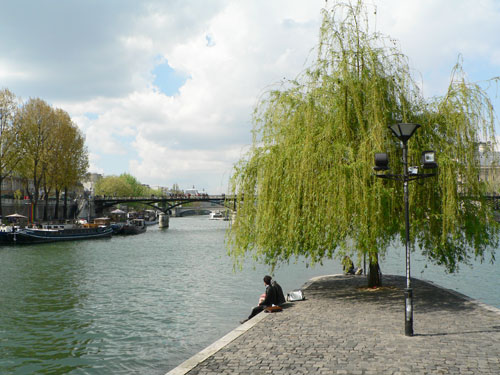
This little triangle of green at the very tip of the island is the Square du Vert-Galant. The air is cooler down here, the river is close enough to hear against the stone, and the boats pass at eye level. Notice how far DOWN you are.

This little triangle of green at the very tip of the island is the Square du Vert-Galant. The air is cooler down here, the river is close enough to hear against the stone, and the boats pass at eye level.

Notice how far DOWN you are. The square sits about seven meters below the streets behind you — close to the level the island stood at two thousand years ago. Paris has been piling itself on top of itself ever since. Down here, you're standing roughly where it started. A Celtic tribe called the Parisii settled this island around two hundred fifty B-C. They fished this river, traded up and down it, and minted their own gold coins — beautiful ones, with wild-eyed horses on them. Then Rome showed up, as Rome did, and the fishing village became a provincial town called Lutetia. The name didn't stick. The tribe's did.

The square's own name is a joke at a king's expense. Vert-Galant was the nickname Parisians gave Henri the Fourth — it means something like the old flirt. He ran through mis

tresses at a pace that impressed a city that is hard to impress. His statue stands on the bridge above you, and the park named for his love life sits at his feet. A weeping willow grows at the very point of the island, right at the water. Every few decades it wears out, and the gardeners replace it with a sapling grown from a cutting of the old one. Technically, it's been the same tree since the e
Hear the full story

Hear this story with audio narration in the Bad Historian app.

Get the App

Quick Facts

  • Square du Vert-Galant sits about 7 meters below street level — close to the island's ancient ground level
  • The Parisii, a Celtic tribe, settled the Île de la Cité around 250 BC and minted their own gold coins with horse motifs; the Roman town was called Lutetia
  • "Vert-Galant" — roughly "the old flirt" — was Parisians' nickname for Henri IV, famous for his many mistresses; his statue stands on the Pont Neuf above the square
  • Jacques de Molay, last Grand Master of the Knights Templar, was burned at this spot on March 18, 1314; he recanted his confession with the fire lit and asked to face Notre-Dame
  • King Philip IV, deeply in debt to the Templars, had every Templar in France arrested on a single morning — Friday, October 13, 1307 — and spent seven years extracting confessions under torture
  • The pope died within a month of Molay's execution, Philip within seven months at age 46, and Philip's three sons died without heirs within 14 years — the French call them "the accursed kings"
Featured Tour

The Islands & the River

9 stops • 34 min

View Tour

Location

Paris, France
Open in Maps