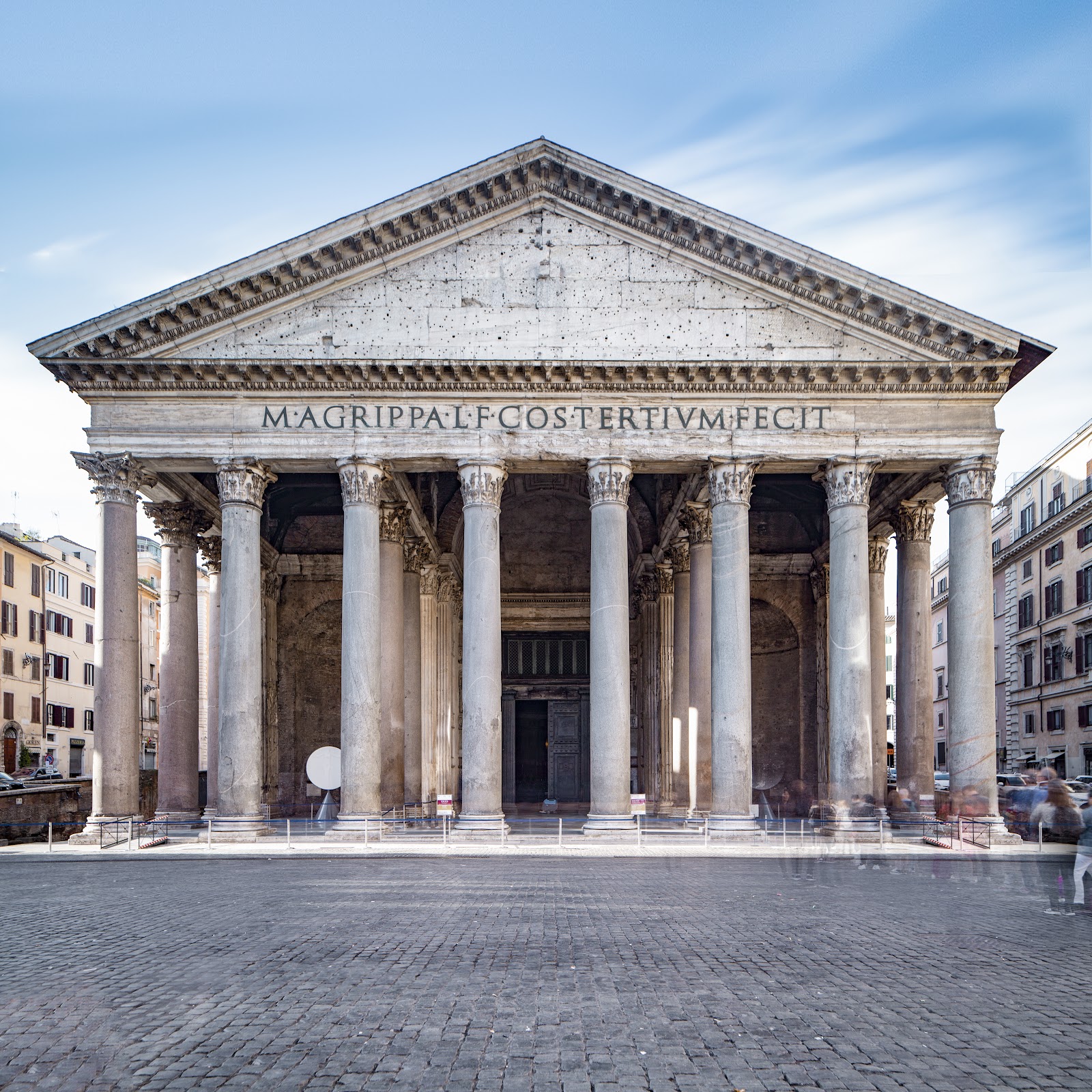
The Pantheon. Look at that portico — those columns are single pieces of Egyptian granite, each one quarried in one block, floated down the Nile and shipped across the Mediterranean around nineteen centuries ago. Read the inscription carved across the front and it credits a general named Marcus Agrippa, who died about a century before this version was even built. The emperor Hadrian actually rebuilt the whole thing, and then, in a strange fit of modesty, left the old name up instead of his own. So the inscription on the most perfect ancient building on Earth is giving credit to the wrong man, on purpose.
But the columns and the sign are the warm-up. The real miracle is the dome inside, and it has never been beaten.
That dome is still the largest unreinforced concrete dome on the planet. Not the largest ancient one. The largest, period. For nearly two thousand years, nobody has poured a bigger one without steel inside it. And the Romans pulled it off with a couple of tricks we only ful
ly understood recently. They graded the concrete — heavy stone at the base, then lighter volcanic rock as it rises, so the dome gets lighter toward the top and doesn't crush itself. And their concrete heals its own cracks. There are little lumps of lime baked into it, and when water seeps into a crack, it dissolves the lime and it recrystallizes and seals the gap. Scientists at M-I-T only worked o