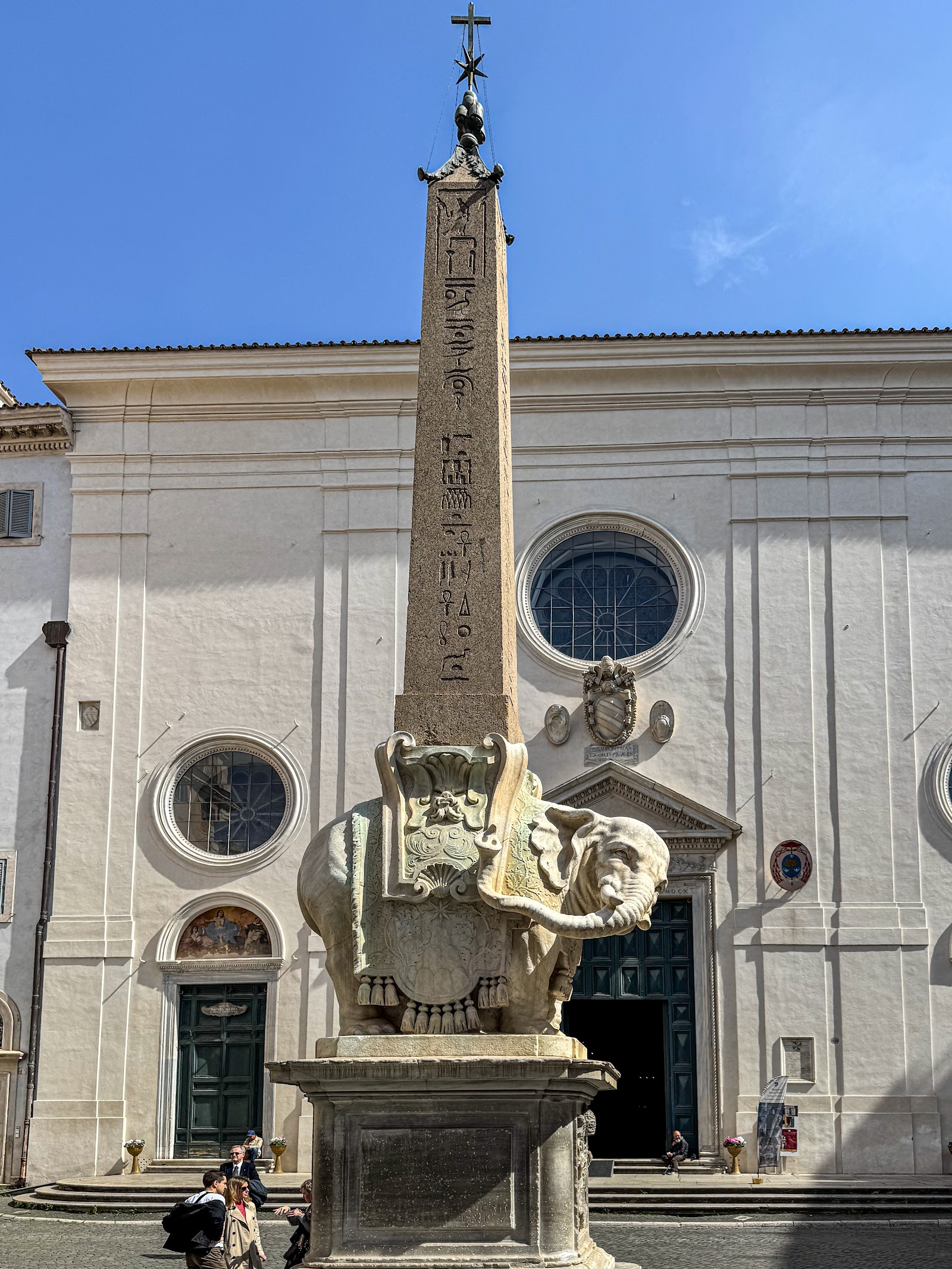
In the middle of this small square stands one of the most charming things in Rome — a little marble elephant with a full-size ancient Egyptian obelisk balanced on its back. It's a Bernini design, and Romans adore it. They nicknamed it the Pulcino della Minerva, which more or less means the little chick of Minerva, because the sturdy stone elephant somehow reads as cute rather than mighty.
The obelisk on top is genuinely ancient — carved in Egypt, hauled to Rome in antiquity, then dug up in this neighborhood and stuck up here in the sixteen hundreds. It's one of the smallest of Rome's many Egyptian obelisks, and the idea of propping it on an elephant came from an old motto — wisdom needs a strong mind to carry it. Hence: obelisk, meaning knowledge, riding on an elephant, meaning strength.
And the obelisk got here because of what's under the church behind it. That church, Santa Maria sopra Minerva, means Saint Mary over Minerva — it's built directly on top of an ancient temple, and tha
t temple was dedicated to the Egyptian goddess Isis. The little obelisk on the elephant's back came from the very same Egyptian sanctuary. The church is also, oddly, the only real Gothic church in Rome — pointed arches, a deep blue ceiling scattered with gold stars, none of which the plain front outside would ever suggest. Inside stands a marble Christ carved by Michelangelo, and the tombs of the