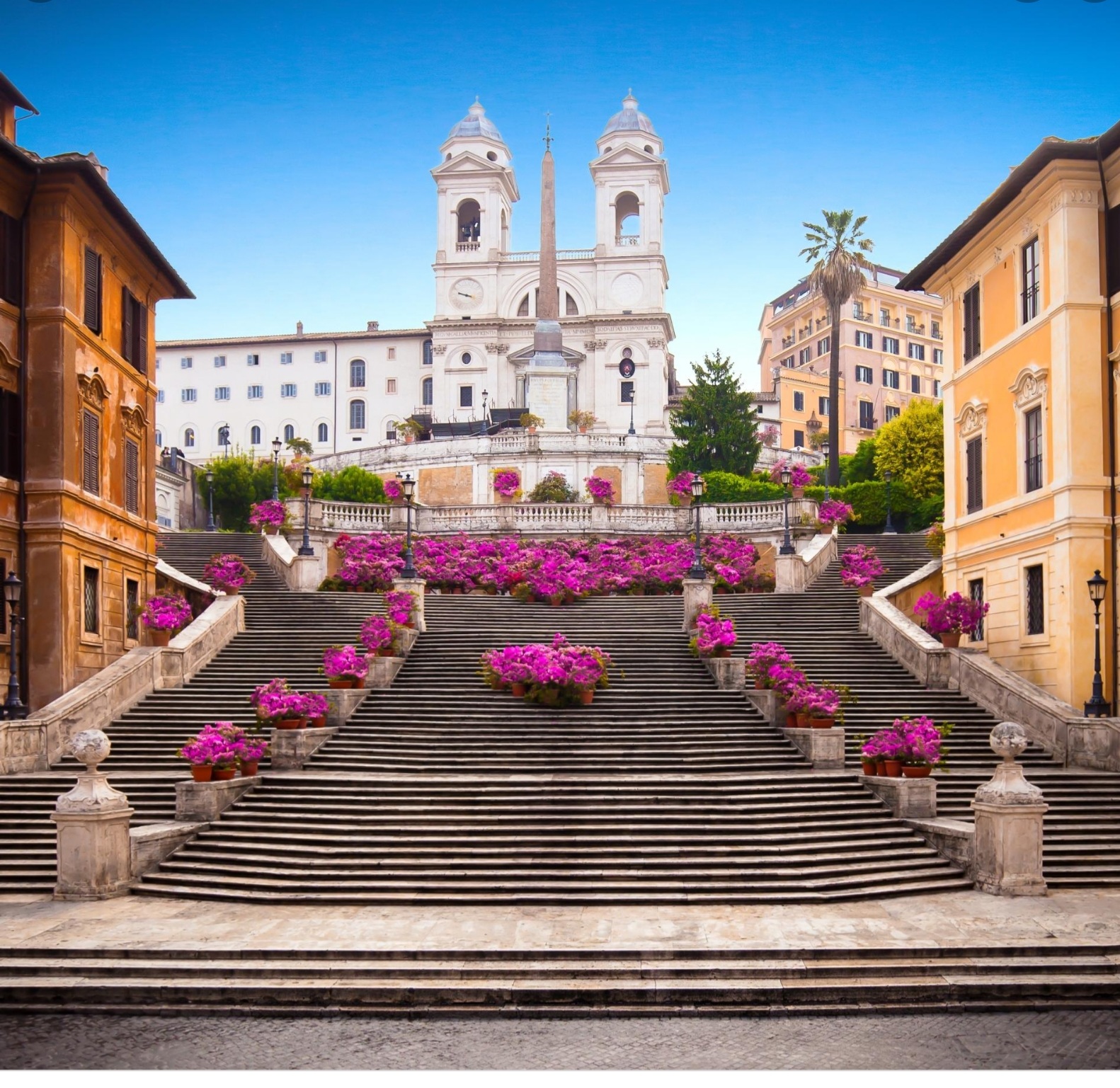
In front of you sweep the Spanish Steps — a hundred and thirty-five stone steps climbing in grand curves up to a church at the top. It's one of the most photographed staircases in the world. And almost nothing about the name is accurate.
The steps aren't Spanish. They were paid for with French money — a bequest left by a French diplomat. They climb up to a French church at the top, Trinità dei Monti, built under French royal patronage. The only Spanish thing here is the building at the bottom, which was the Spanish Embassy to the Vatican. So the embassy lent its name to the square, the square lent its name to the steps, and now the whole world calls a French staircase leading to a French church "Spanish." Rome does not care. Rome has been misnaming things confidently for three thousand years.
These steps are famous for something else, too — at flowering time each year, they're banked with hundreds of pots of pink azaleas, so the whole staircase becomes a cascade of blossom. And the s
treets fanning out from the bottom are the most expensive shopping in Rome. One of them, Via Condotti, holds the Antico Caffè Greco, open since seventeen sixty — the oldest café in the city. Casanova drank there. So did Goethe, Byron, and Keats. Two and a half centuries of writers, rogues, and tourists have all argued over coffee in the same rooms.
At the base sits a low fountain shaped like a ha